Kingsland
Kingsland
Overview
- 4 layout templates
- Module kit · A, G
What We Did
The Outcome
The Premise
Agency case studies have to flex per project. One template flattens; ten bespoke pages don't scale.
Kingsland is a Brooklyn brand agency, the studio behind, among other things, the Jaywalk Rye identity that lives elsewhere in this portfolio. Their work spans editorial brand systems, packaging, identity, web. Each project carries its own pace and its own visual language.

Their case-study surface had to do the same thing, carry every kind of project they make, without making each one look like the last one. The brief: build a wireframe template system the team could use to shape every future case study, without losing the ability to make any one of them feel specific.
Two ways that fails by default. A single fixed template flattens every project into the same rhythm, bottle shots and editorial reports end up reading the same. Ten bespoke pages, on the other hand, can't be maintained, the team rebuilds the wrapper every time a project ships.
The right answer sits between them. A small set of layout templates, each built from interchangeable modules, that the team can mix and reshape per case study without ever leaving the system.
Two Layers of Modularity
The system has two scales. Layout templates set the overall pace of a case study. Modules build the individual sections inside them. Both are interchangeable; each one was wireframed before any visual design touched it.
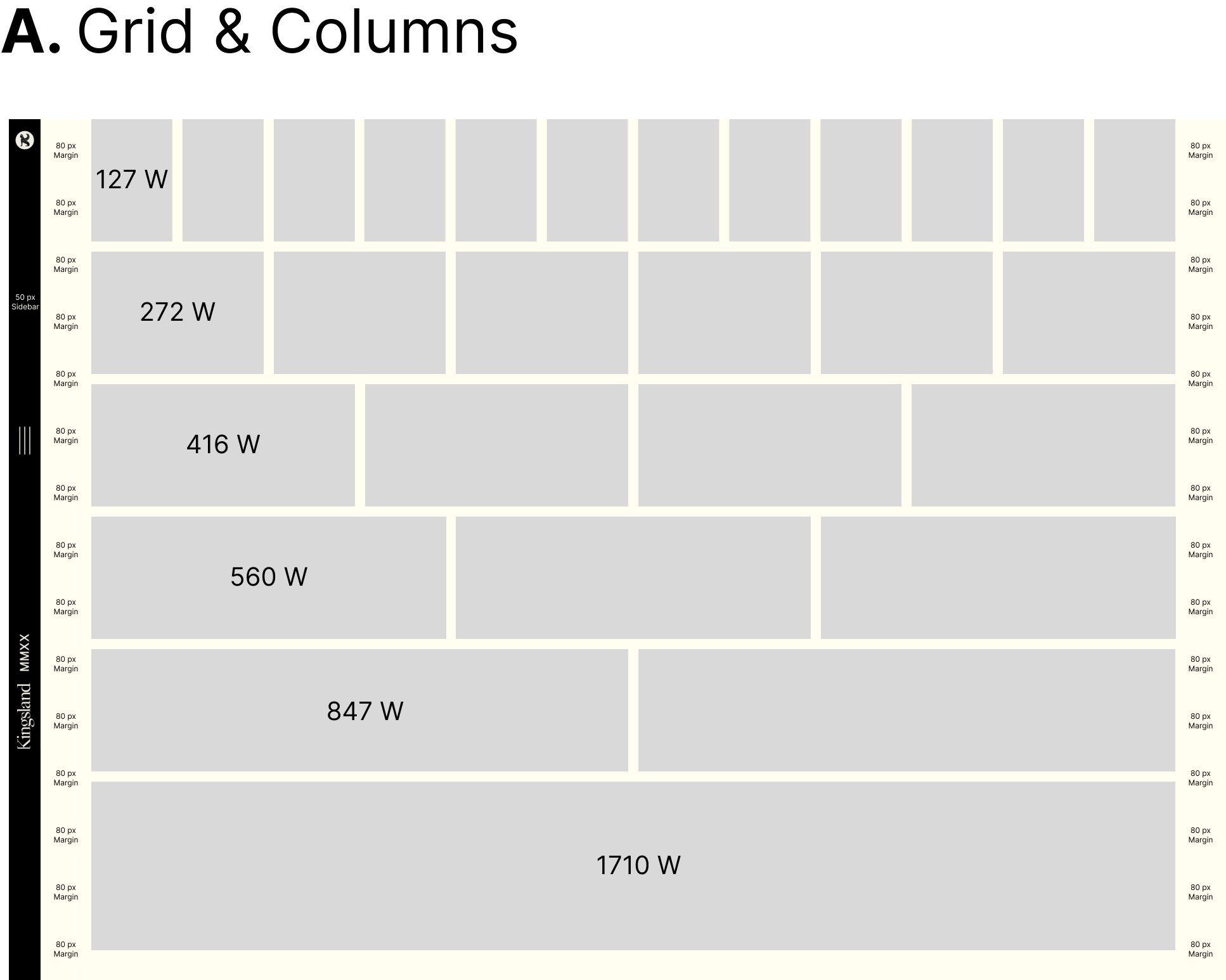
The visual design layer comes after, whoever themes the templates can apply Kingsland's identity (or any brand's) on top without disturbing the structure. That's the contract: the system carries the rhythm, the brand carries the finish.
layout templates · the pacing of each case study
component groups · A to G, swappable in any order
bespoke pages required · every case study assembles from the kit
wireframe systems · structural design, not visual finish
The Four Layouts
Four wireframe templates, each one a full case-study page assembled from the same module kit. They share a spine (header, intro, challenge, motion, solution, content grids, social posts, results) and differ in how the middle is paced. The team picks the closest fit, then reshapes the modules inside. Pick a layout, then scroll inside it to read the full wireframe.




Layout One · Mixed. Balanced editorial and visual. Varied content-grid tiles and paired columns between the story beats, the default when a project has both writing and a body of work to show.
Layout Two · Minimal. Sparse and breathing. Big single images, generous whitespace, a light grid, for projects where a few hero shots carry the whole story.
Layout Three · Gallery. Portfolio-dense. Stacked multi-tile masonry grids through the middle, for identity systems and image-heavy work with a lot to show.
Layout Four · Split. Paired and split. Divider-led split heroes and two-column comparisons, for before/after, A/B, or twin-track projects.
The Template, In Use
The proof the system holds. Two case studies built from the same four-layout, A, G kit (same spine, header to results) themed for two completely different brands. The structure carries the rhythm; the brand carries the finish. Neither looks like a template, and neither looks like the other. Pick a page, then scroll inside it to read the full layout.


Same skeleton underneath both: a header, an intro, the challenge, a motion beat, the solution, the content grids, the social posts, the results. Kamoti runs it dark and product-forward; Añejo runs it warm and editorial. The system never shows, which is the whole point.
Why Modular
A template system is the part of an agency's site that has to keep up with the agency's own work. Build it once, edit forever.
Agency case-study sites have a specific failure mode: they get built once, work for a year, and then the work outgrows them. New project doesn't fit the template, so the team builds a one-off. Three one-offs later, the site is a museum of inconsistent layouts and nobody wants to ship the next case study because it'll need its own page too.
A template system fixes the trap by refusing to be a single page. Layouts cover the broad pacing decisions. Modules cover the granular ones. The team adds new modules as new project types appear; the layouts pick them up automatically. The site grows without ever needing a redesign.
That's what this work was. Not a website. The thing that lets the website keep working as the agency keeps working.
layout templates · the rhythm of each case study
component groups · A, G, reorganizable inside any layout
bespoke pages · every project assembles from the kit
wireframe systems · designed to be themed by anyone