Lot
Lot
Overview
- Product design
- Source readers
- Search and filters
- Source database
- Mac app
What We Did
The Outcome
Search every place a car is sold at once, on your own computer
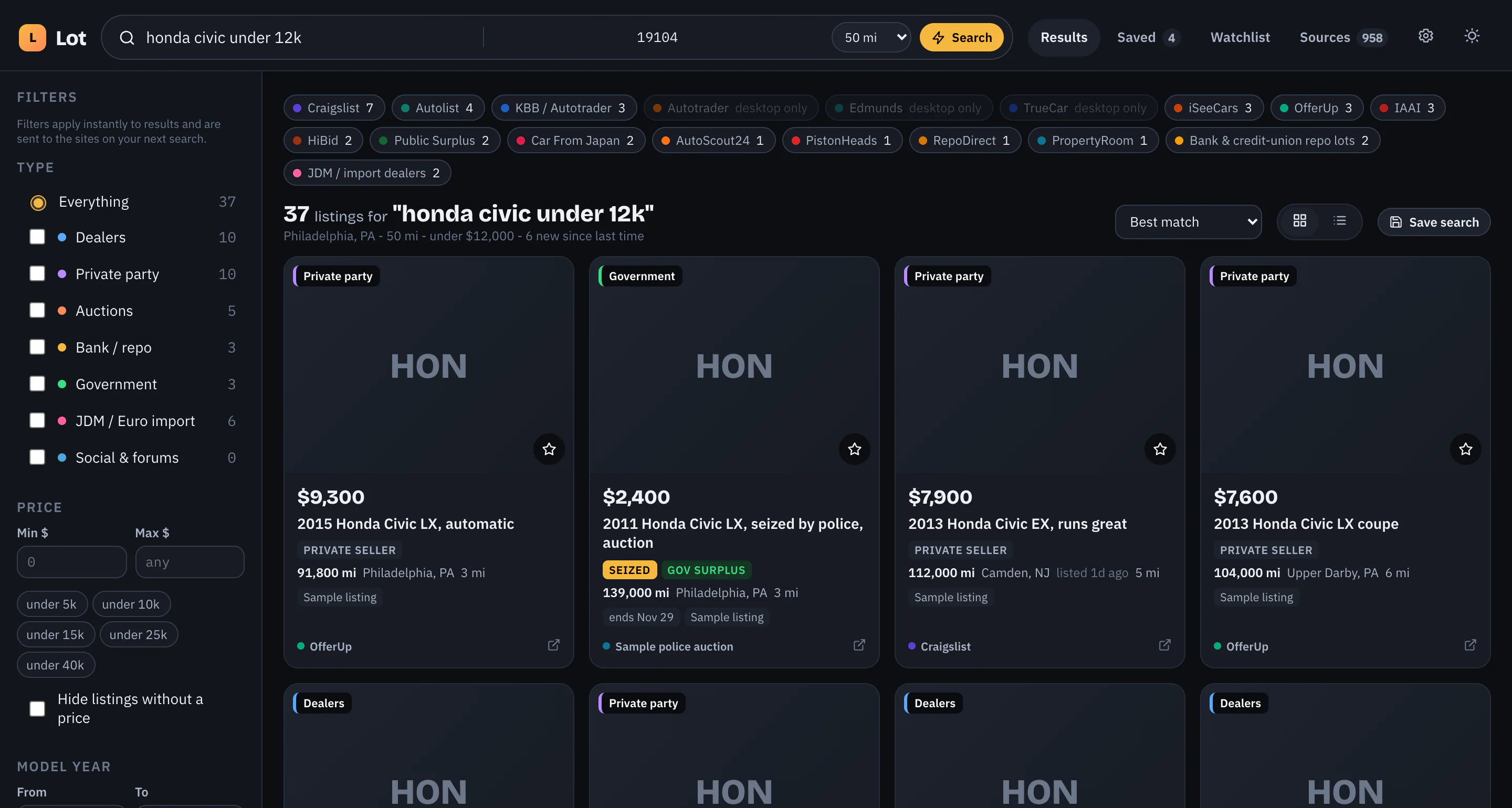
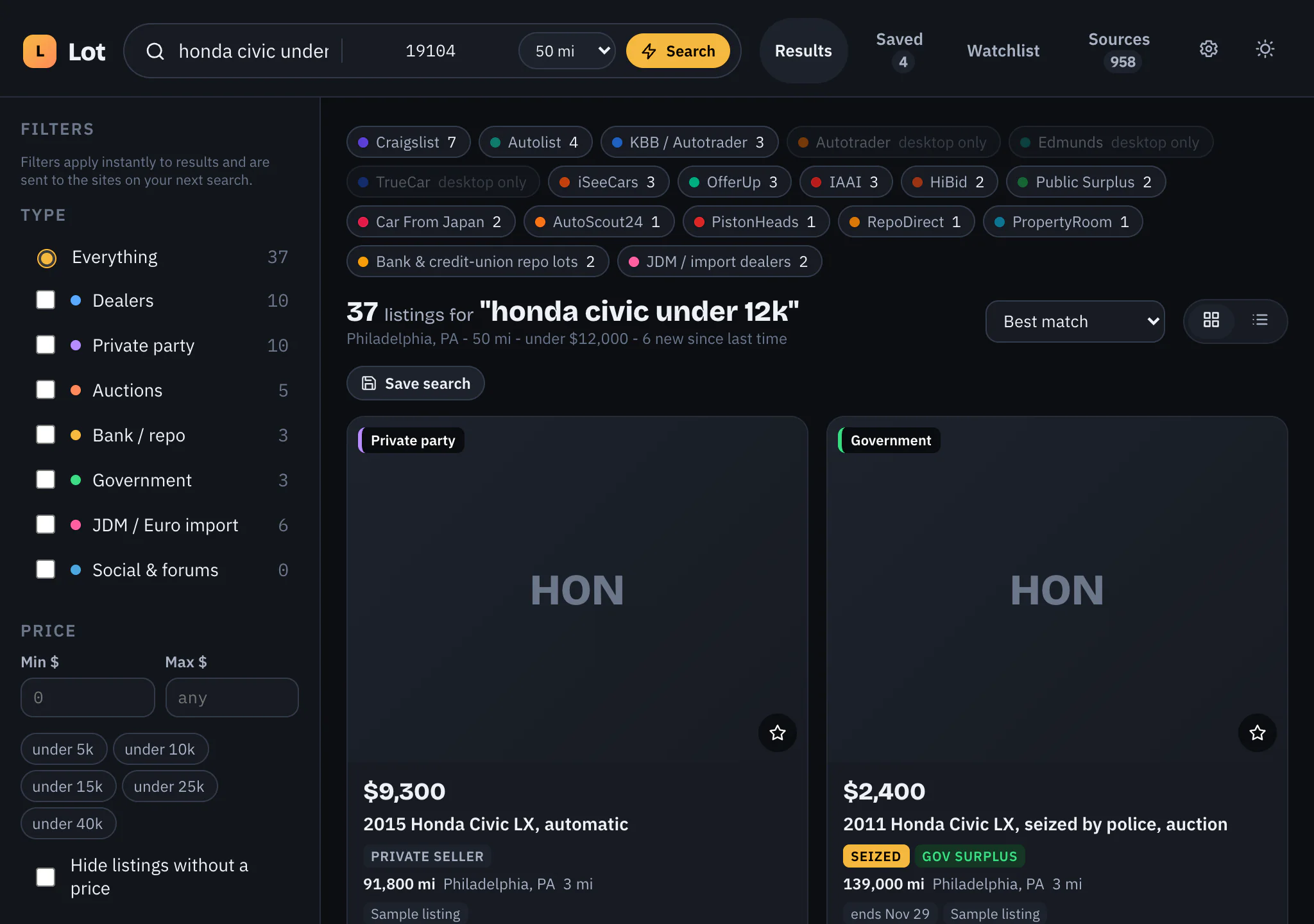
The brief was a personal vehicle finder. Scan the auto dealers, the private listings, the auction houses, the bank and repo sites and the government surplus sites, and show every car that fits one search.
Three limits came with it. The person types what they want in their own words. A short setup runs the first time, and there are no accounts. And it ships as a Mac app that keeps everything on the computer.
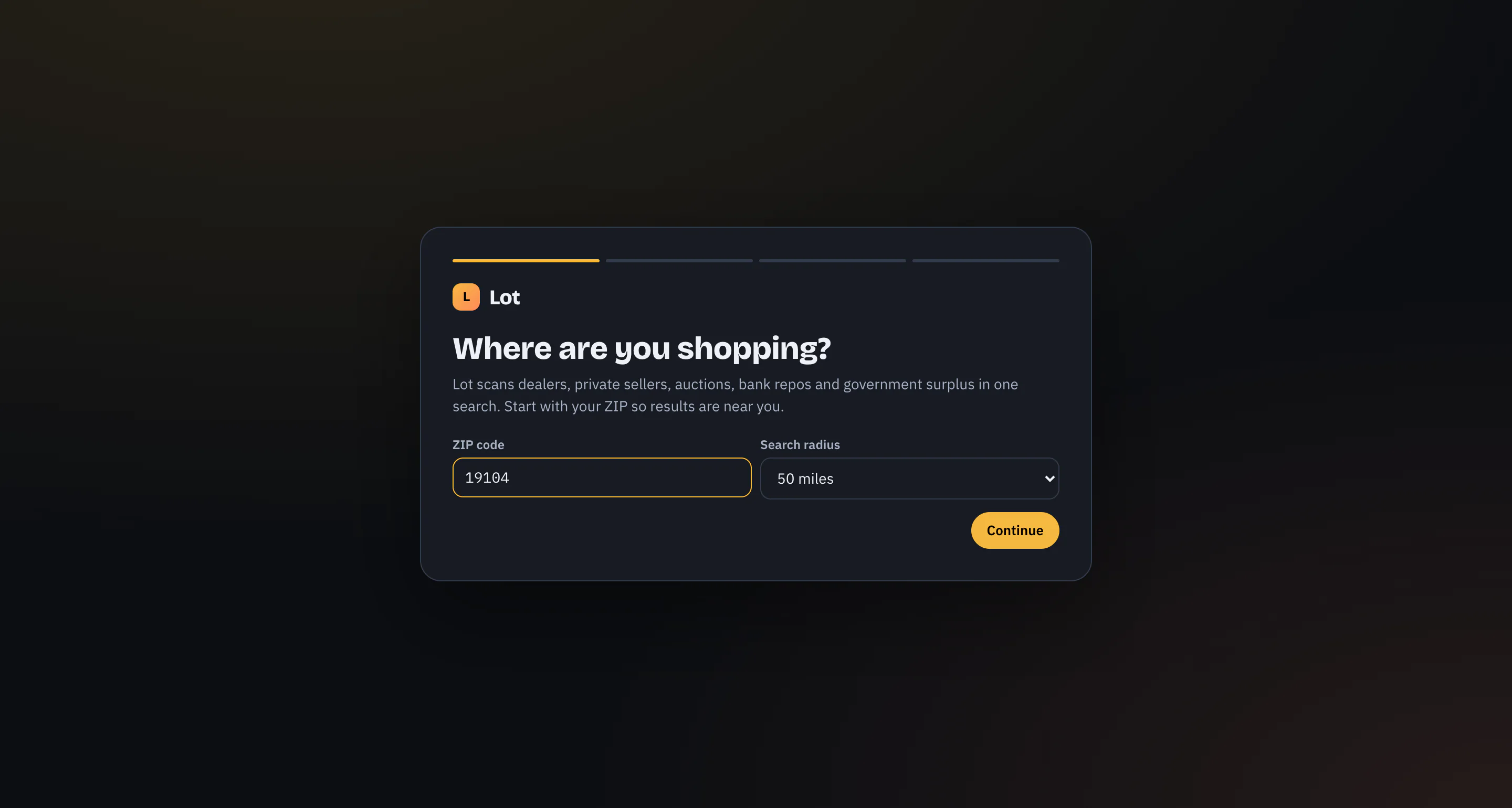
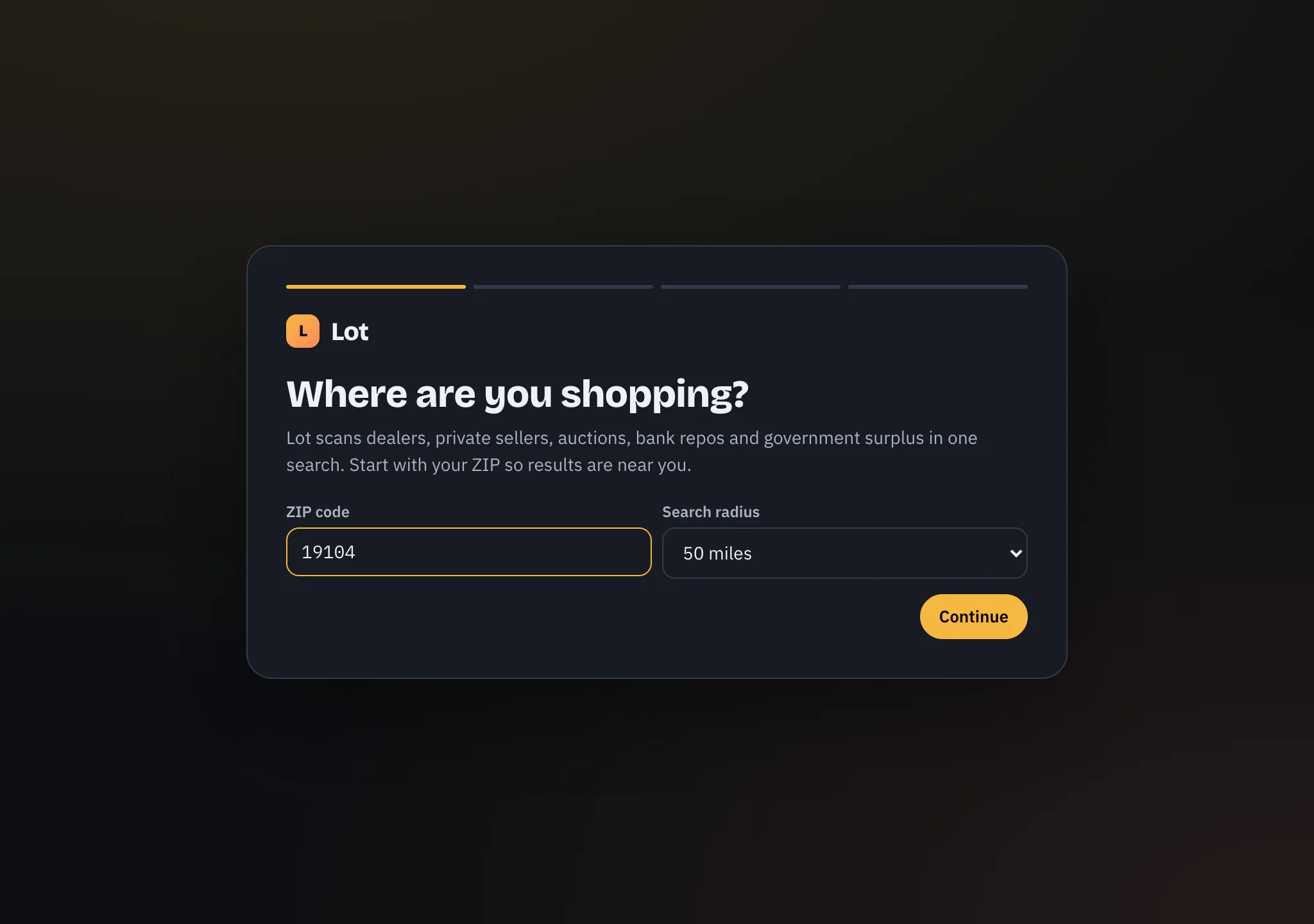
We were the whole team: product, design and engineering, start to finish
Therum was the whole team. We wrote the design notes and built the source readers, the query parser, the merge and the filters. Then we built the saved searches, the watchlist, the backup file and the Mac app around them.
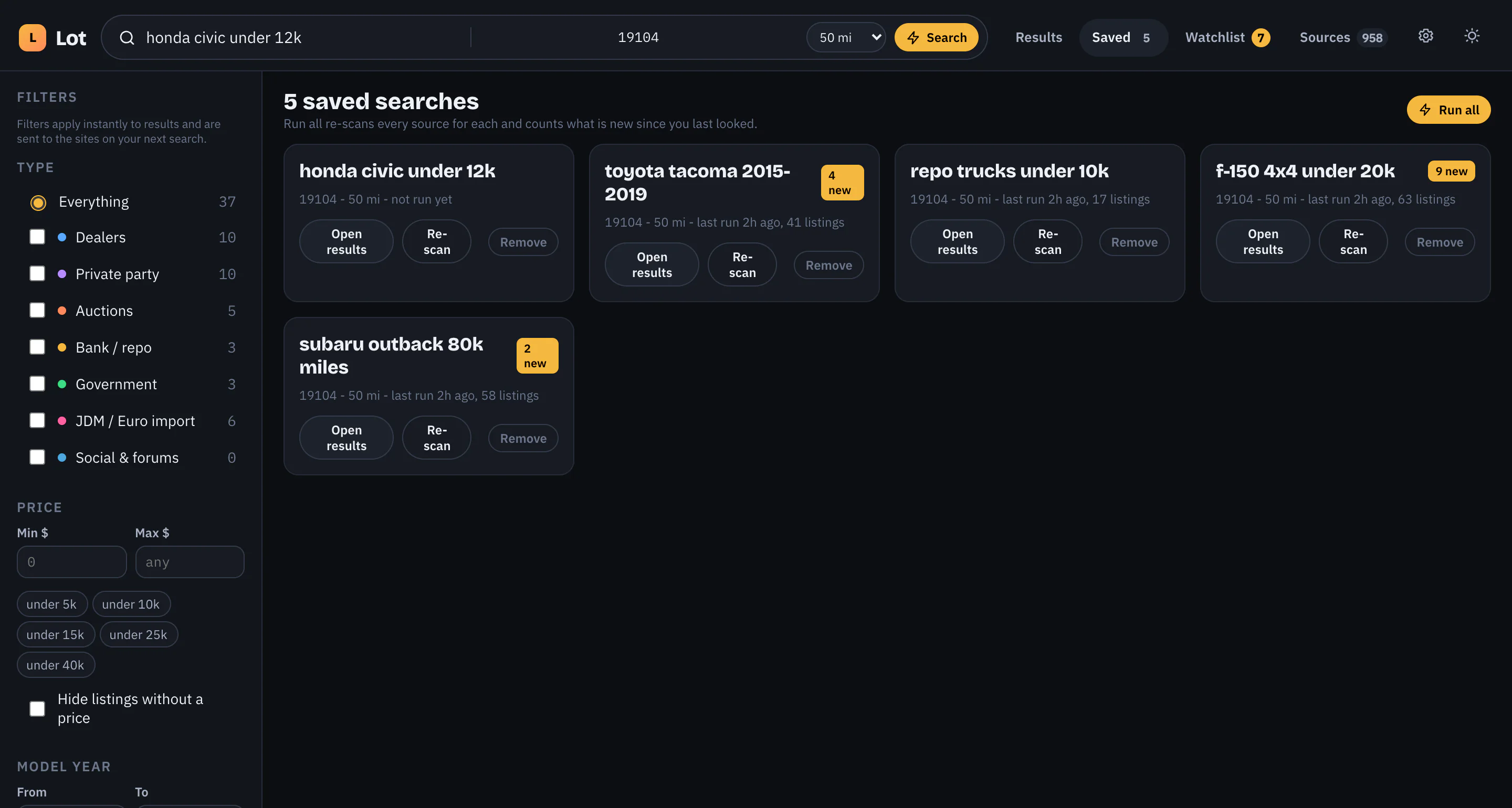
A search reads in plain words. Type a year, a make, a model, a price cap and a mileage cap in any order and Lot sorts them out. Shorthand such as r34, supra or miata becomes the full car, and a word like repo turns on repo mode.
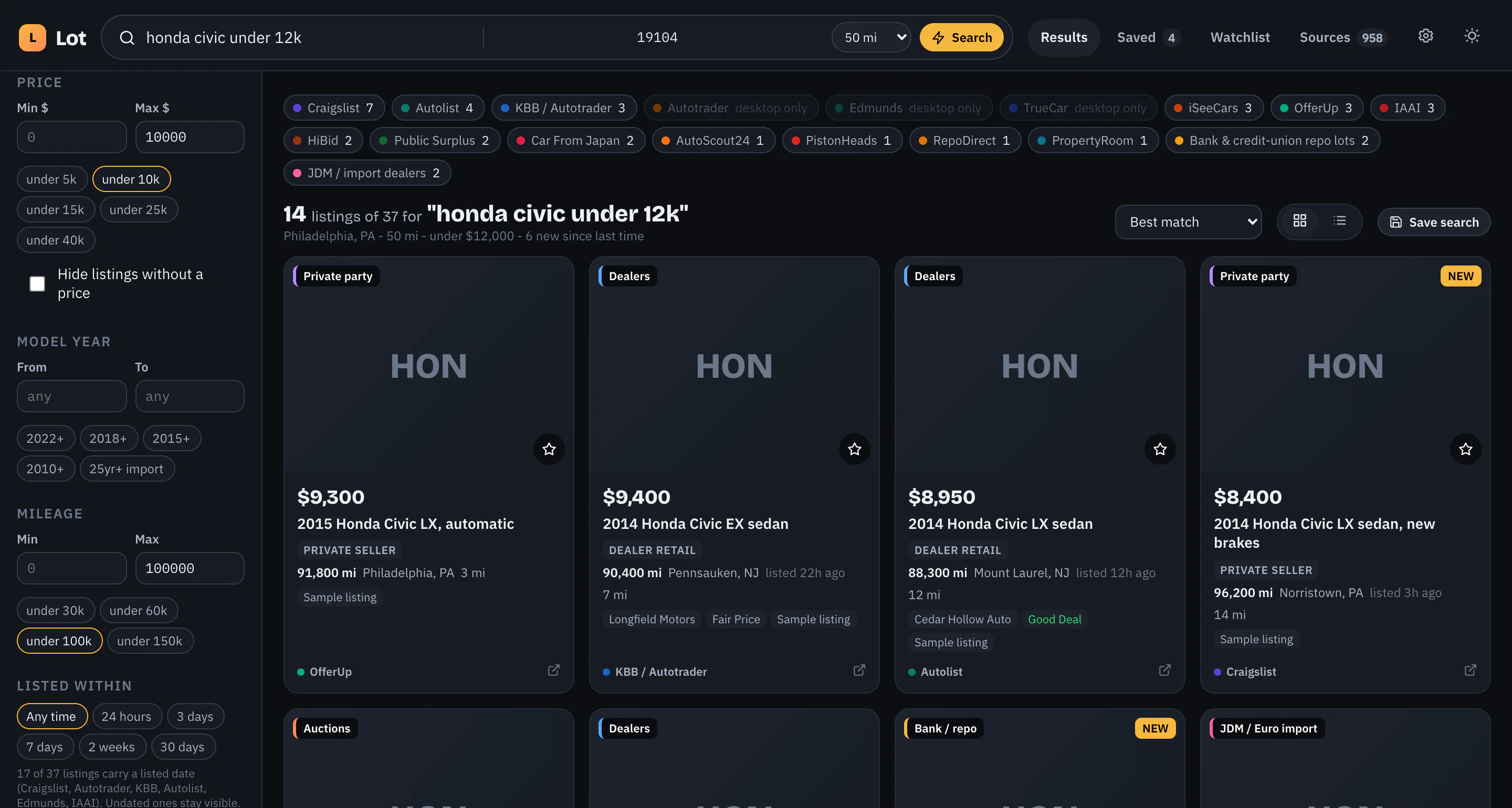
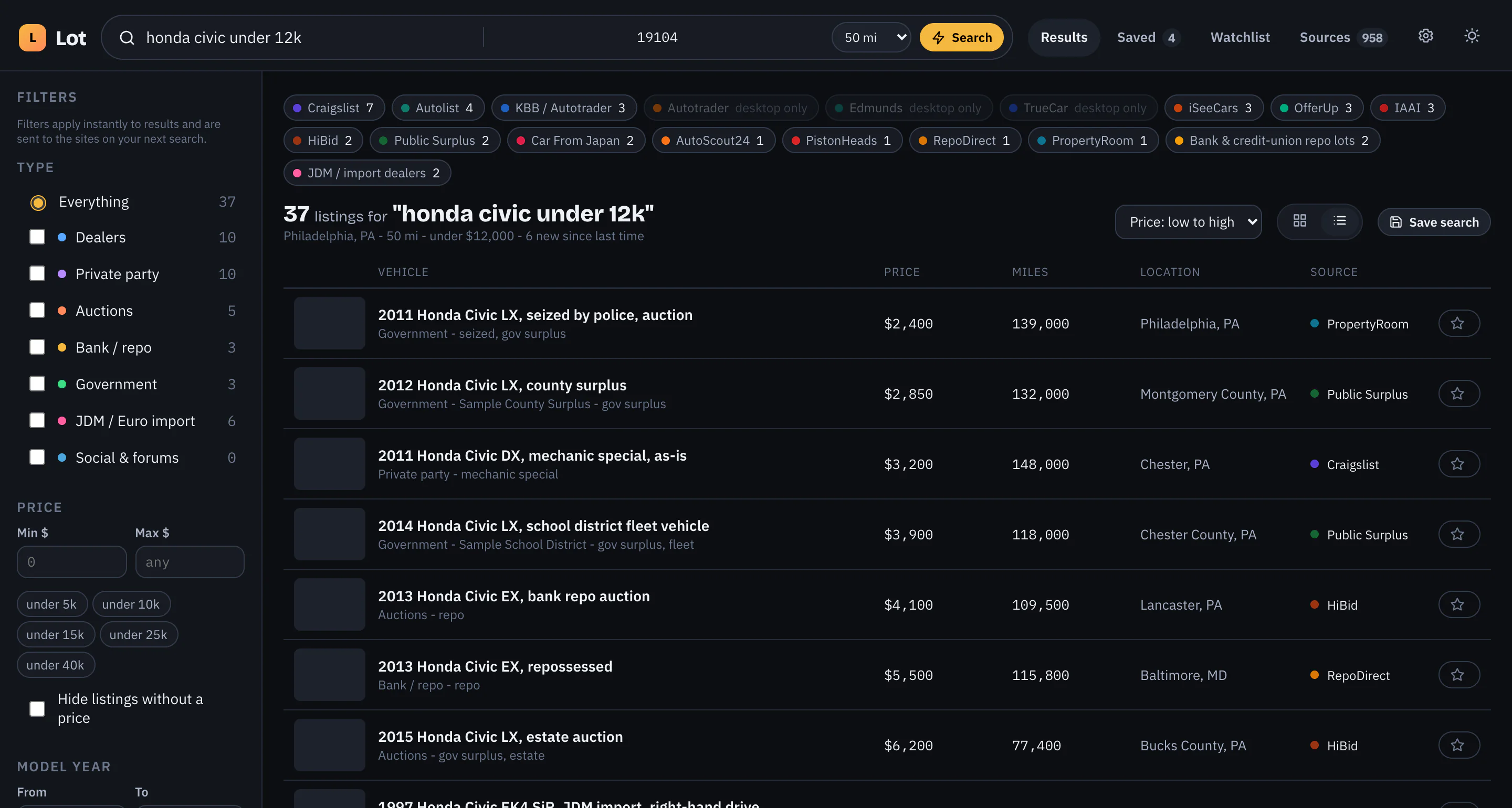
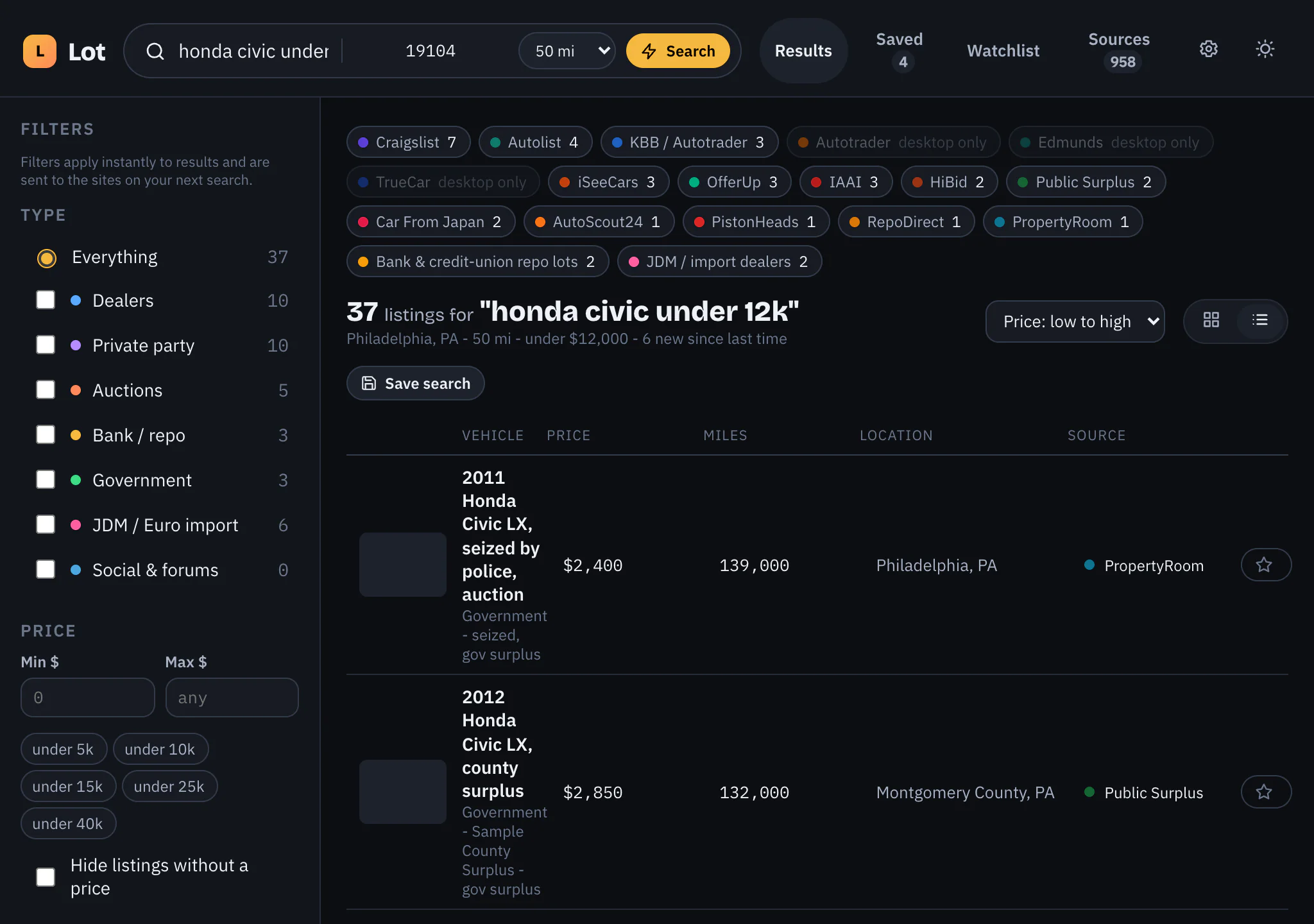
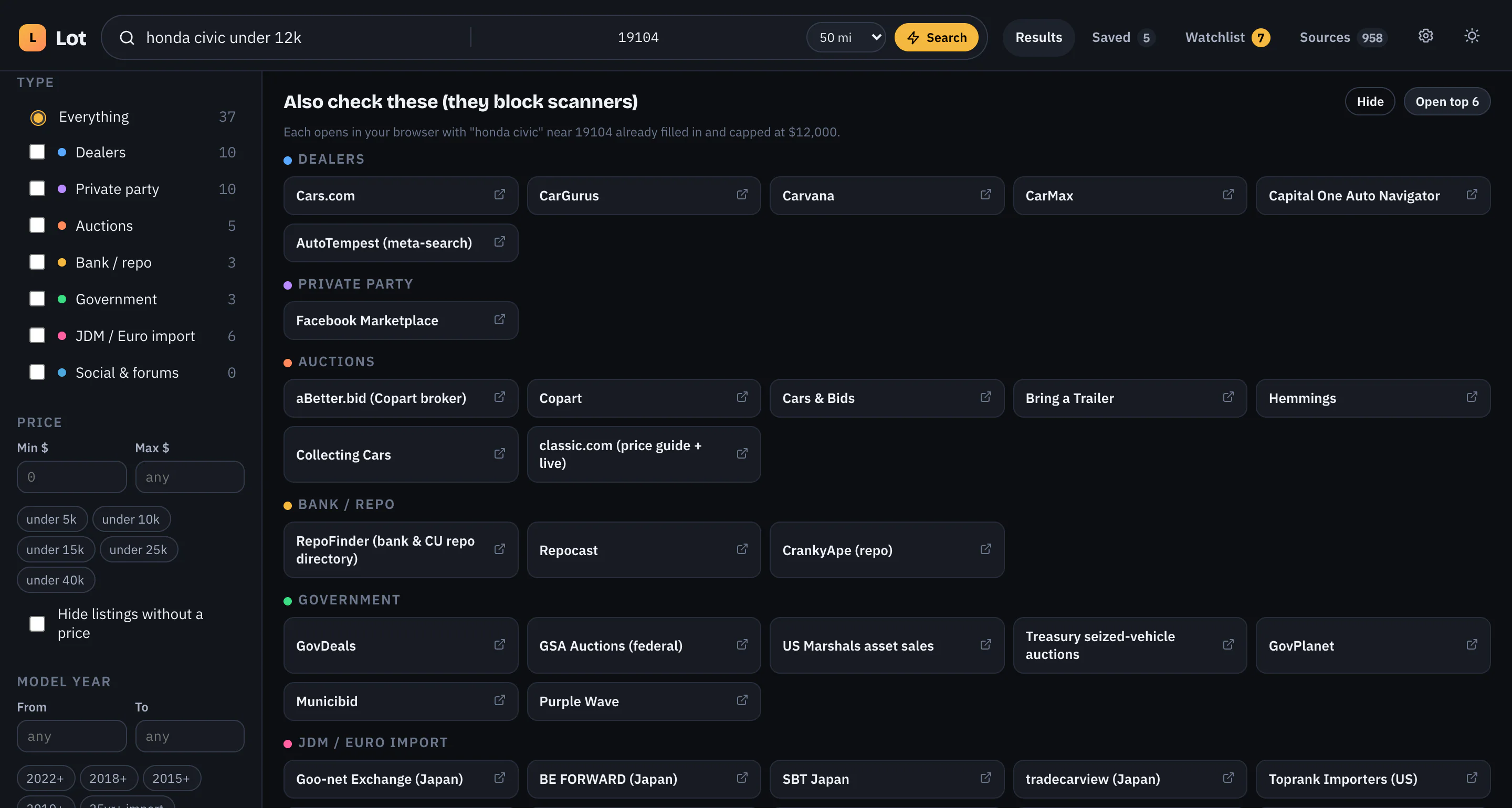
Every listing gets a tag for what it is, taken from its own words and its source: repo, seized, government surplus, fleet, salvage title, clean title or import. The filter rail narrows by price, year, mileage, listing date, distance, state, body style, transmission, those tags and the source.
We checked it as we built it. An offline parser check, a live smoke test against the sources, and a probe that finds the dealer inventories Lot can read directly.
Probe each site, read what it already publishes, and fall back one step at a time
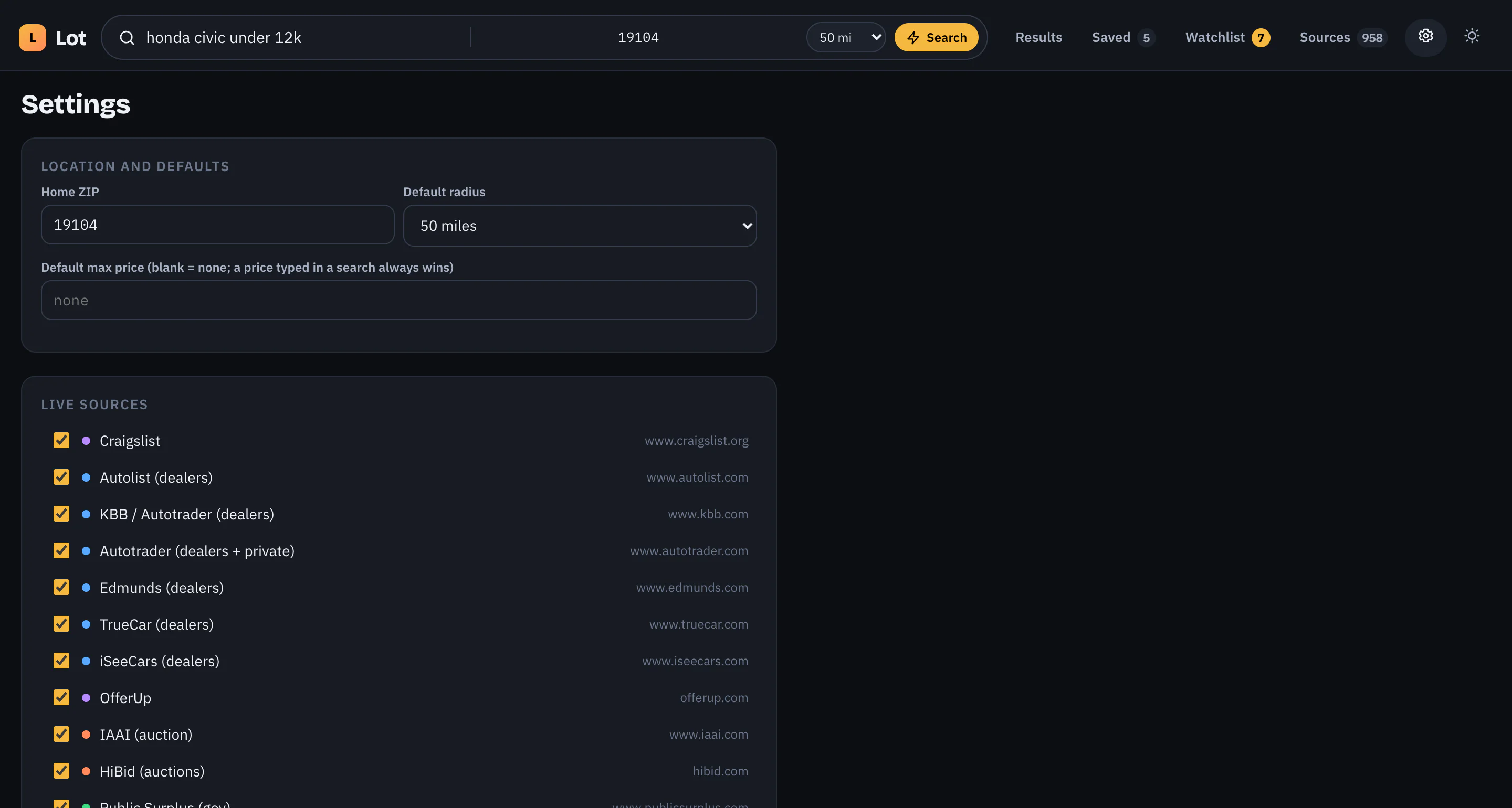
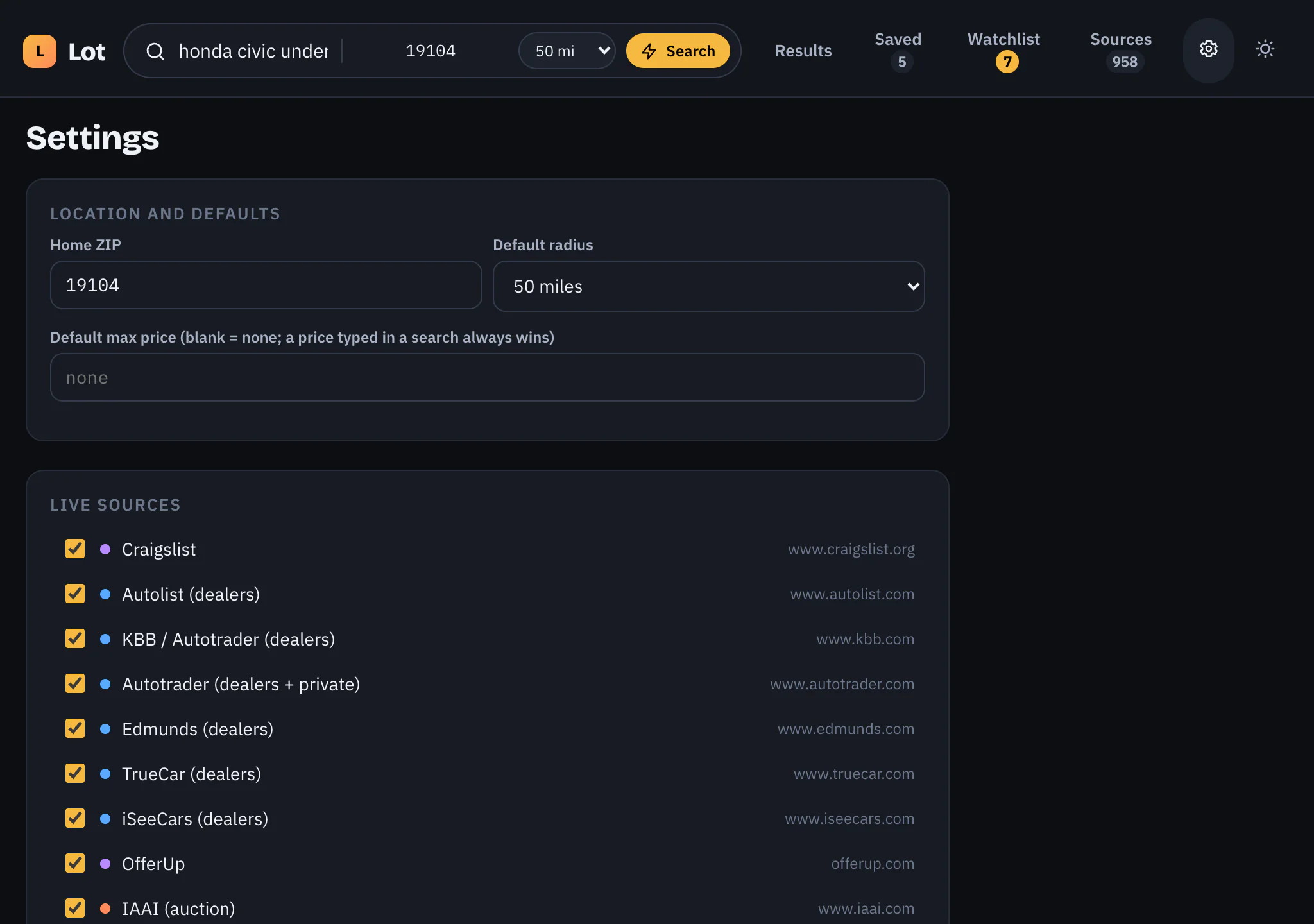
We probed each site with a plain request first. A site that answers gets a normal reader. A site that answers only a real browser gets a reader that runs in the Mac app, where our own network client sends browser headers. Autotrader, Edmunds and TrueCar work this way. A site that refuses both ways opens as a link with the search already filled in.
Many import dealers run Shopify or WordPress, and both publish their whole stock as data. A probe finds those hosts, and Lot reads 45 dealer inventories directly, eight at a time, with a 15 minute cache. Every reader returns the same shape of listing, so the merge, the duplicate check and the junk filter work on all of them.
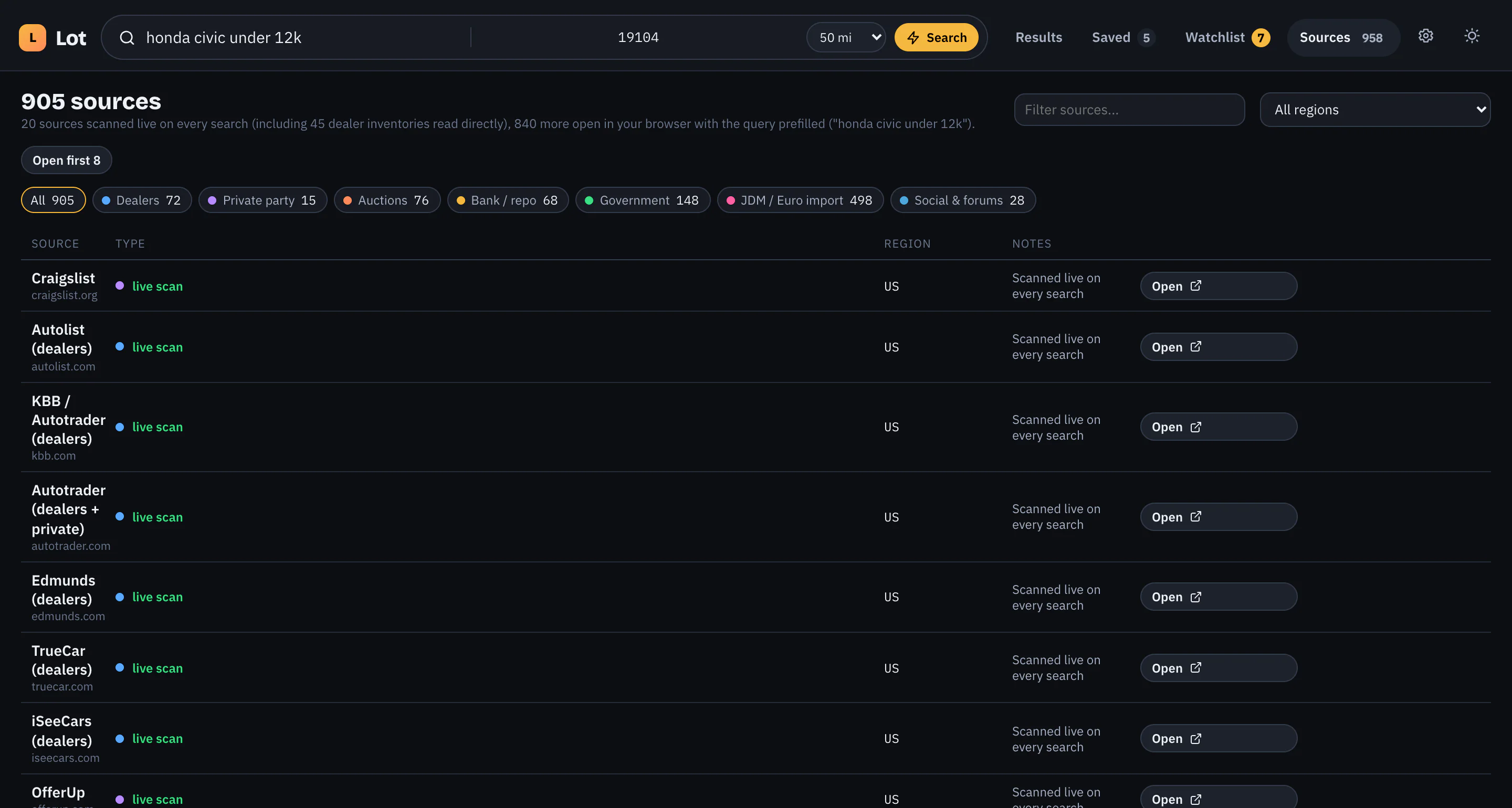
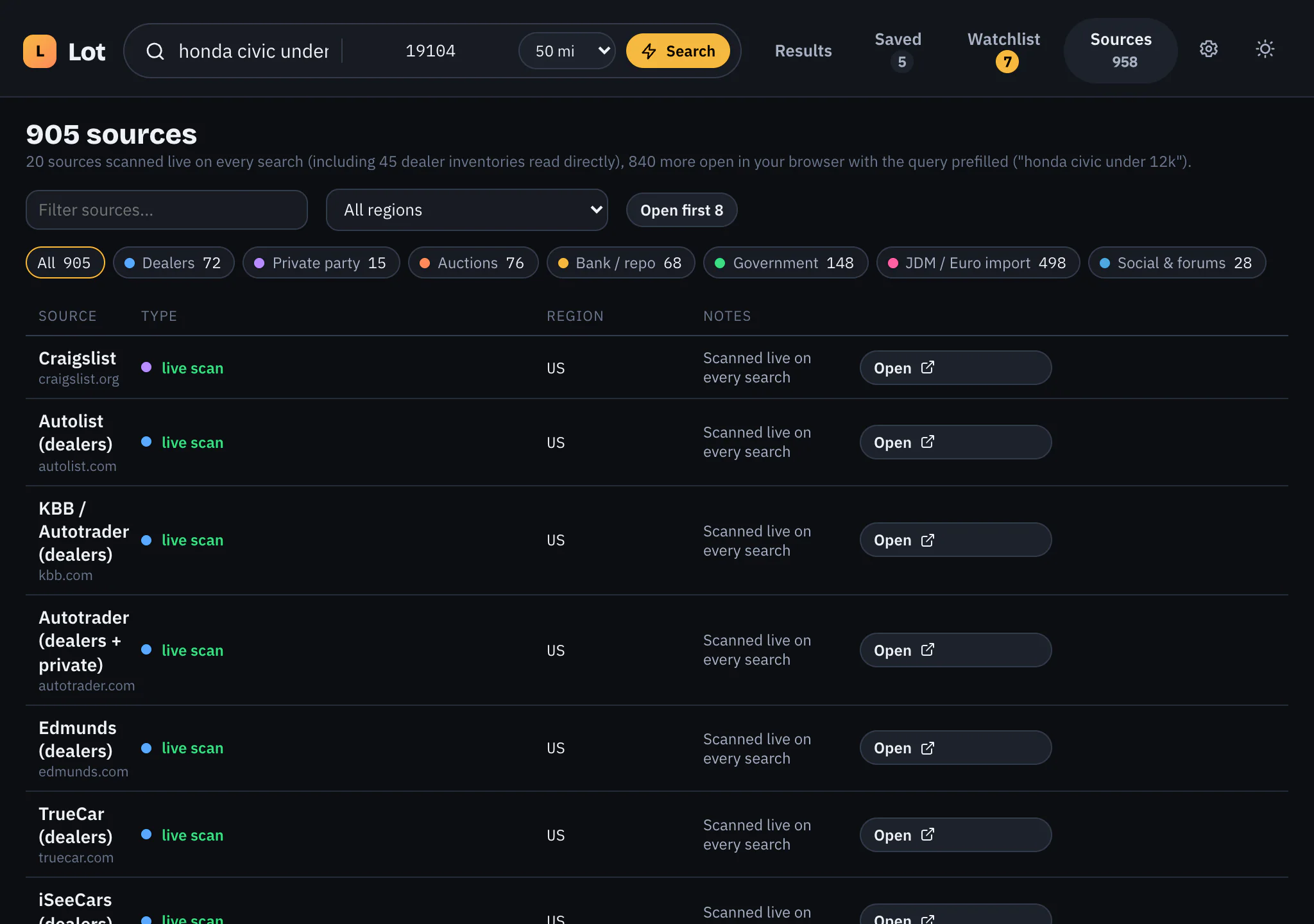
The source database came from nine research sweeps. They returned 1,289 raw entries. A script merged them by site, probed each one and dropped the dead and the dealer only ones. 895 remain, written by that script and never edited by hand.
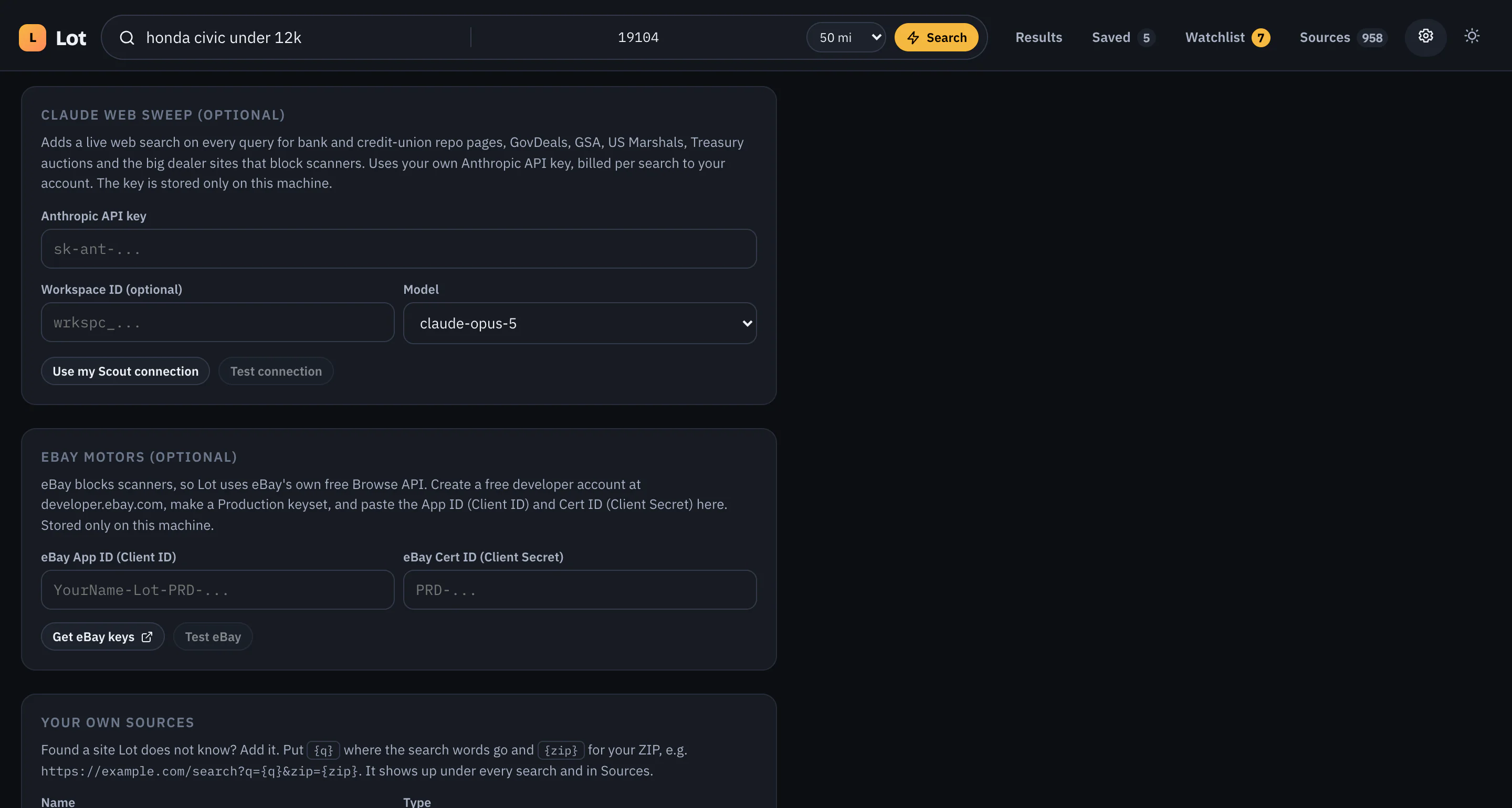
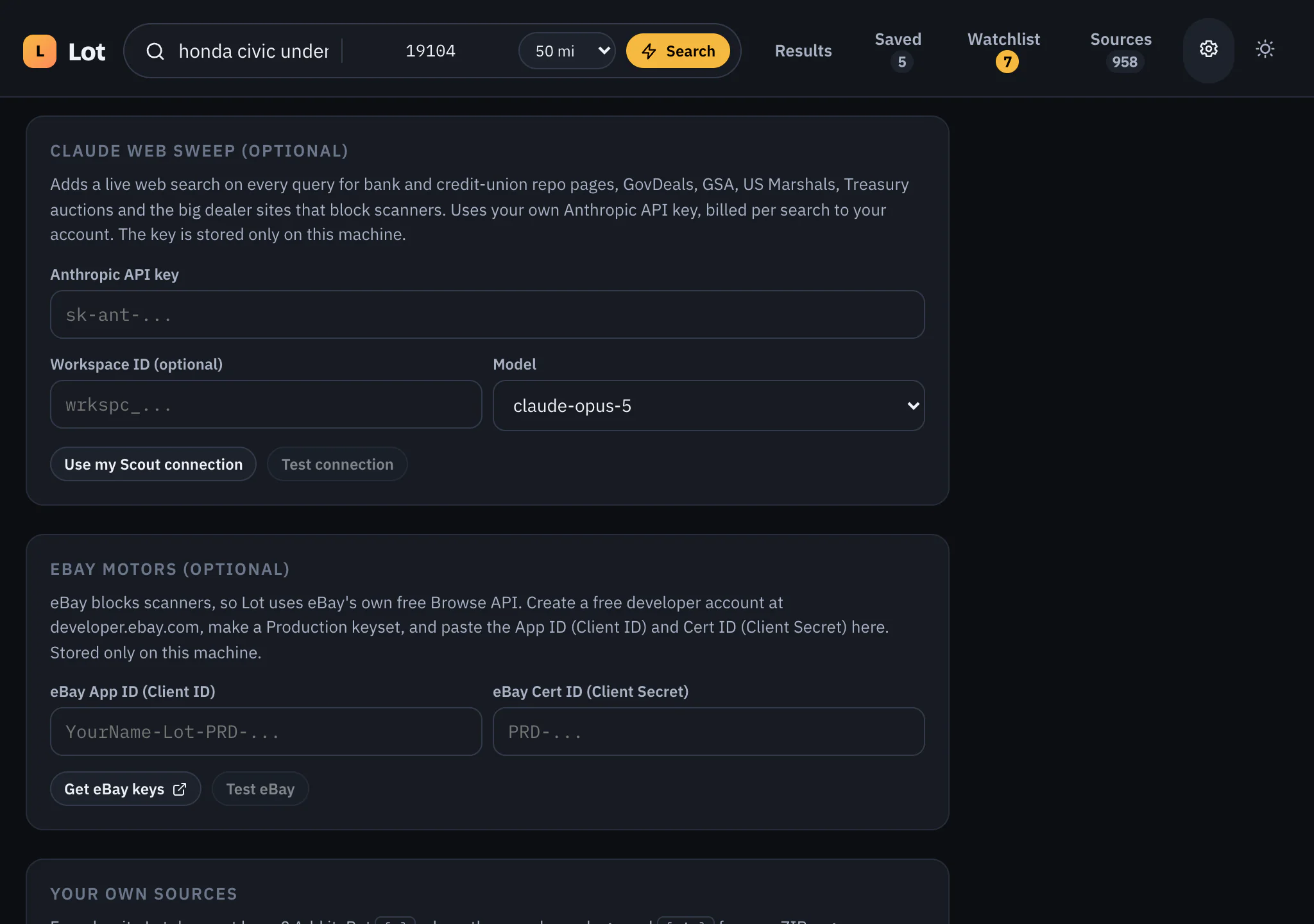
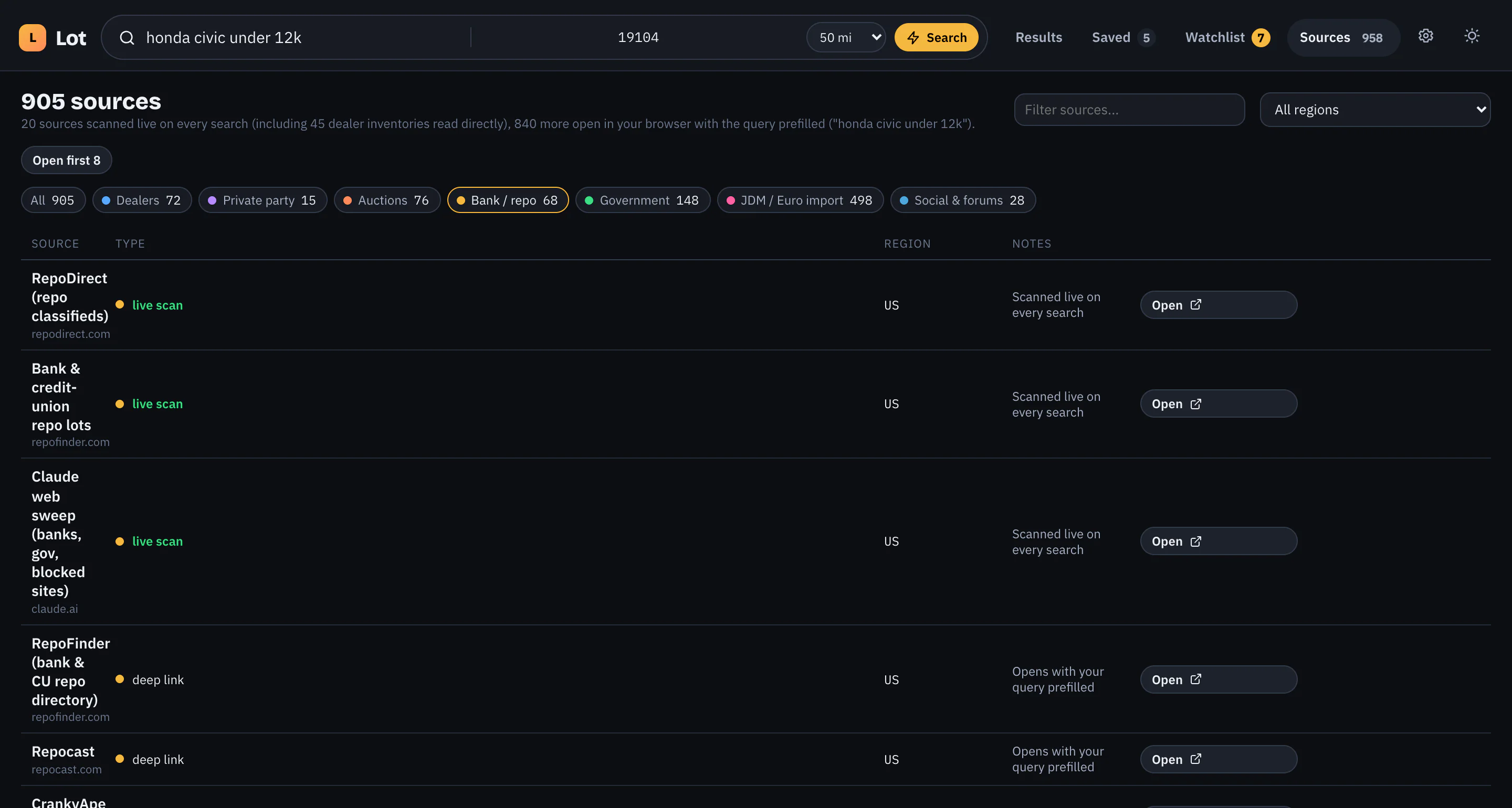
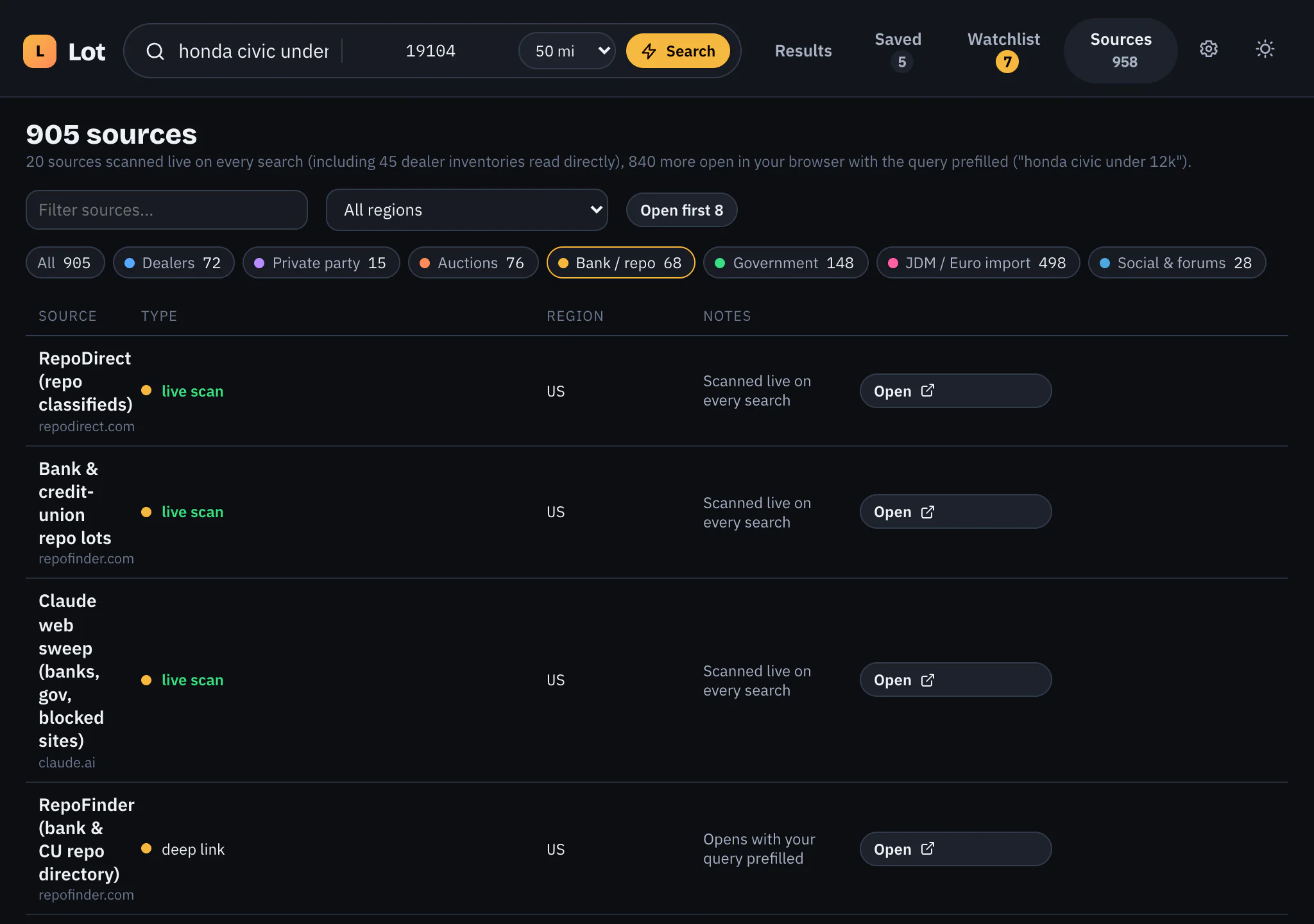
Bank and repo cars had no single public feed to read. Banks sell through dealer only auctions, and credit unions post on their own pages. So we added readers for credit union repo pages, HiBid, RepoDirect and PropertyRoom, and an optional Claude web sweep that runs on the person's own key.
Everything stays local. Lot has no account and no server of its own. Settings, saved searches and the watchlist live in the app's own storage, and any keys stay on the same computer.
A Mac app, a source database and a card that says what each car is
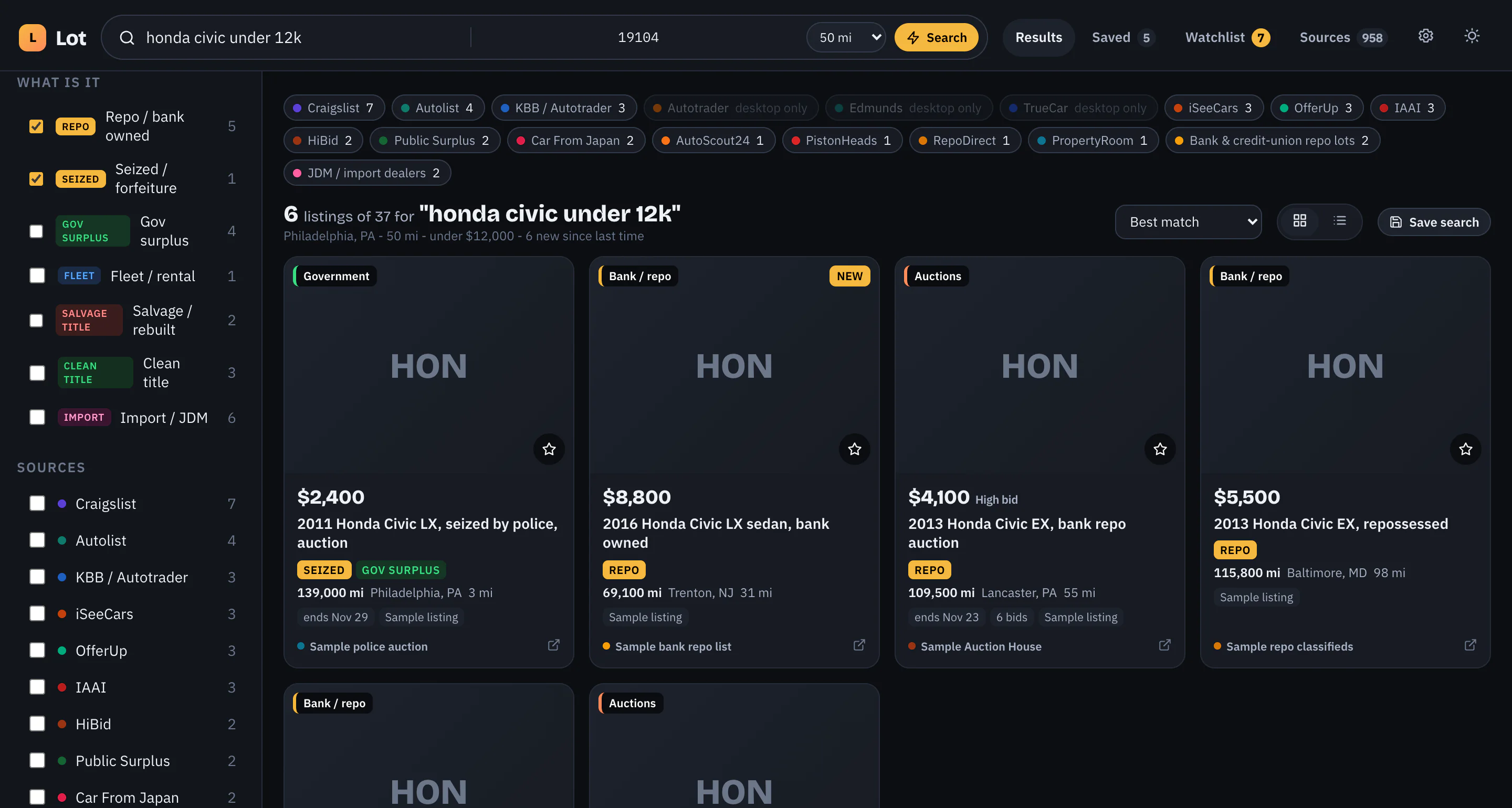
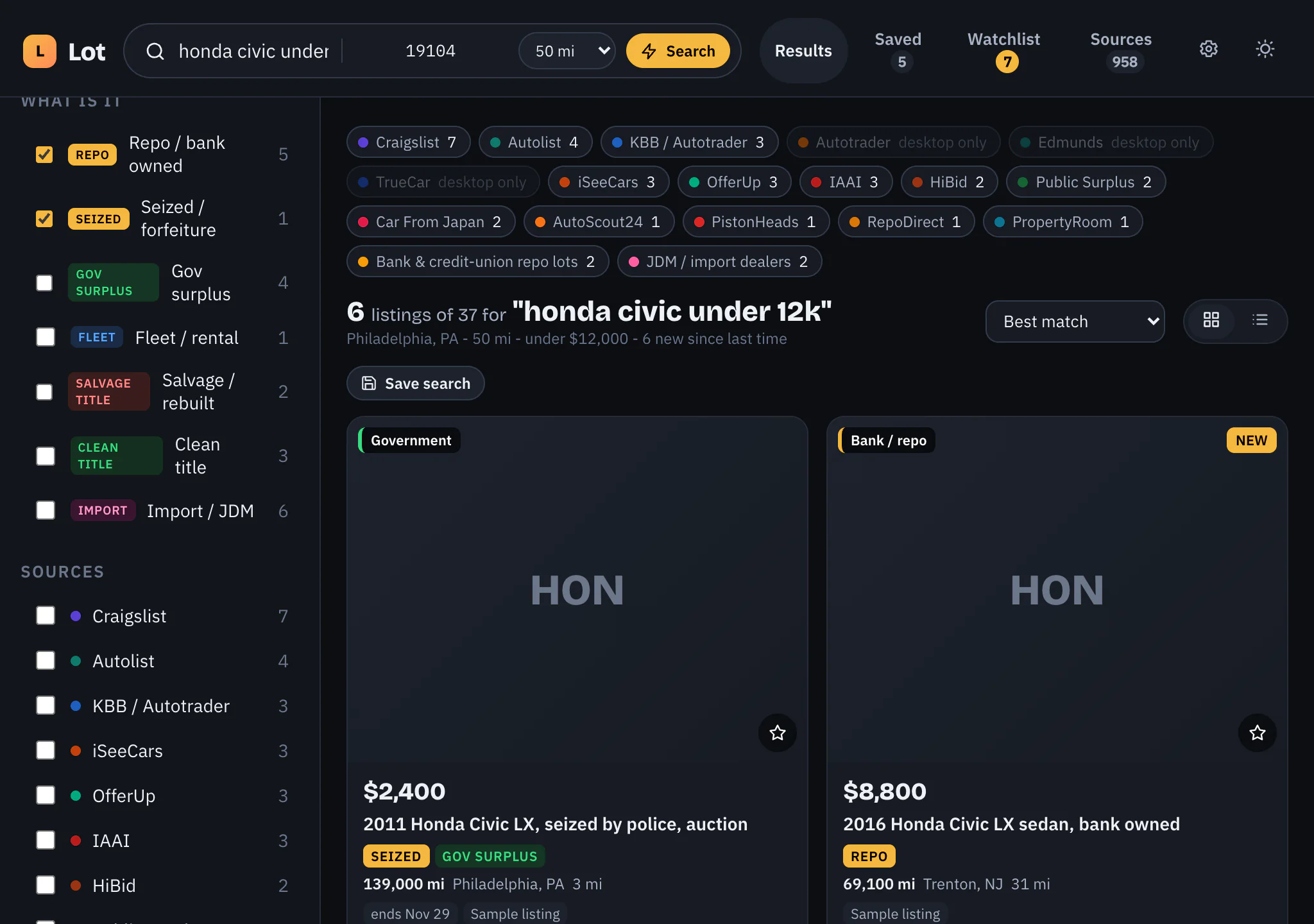
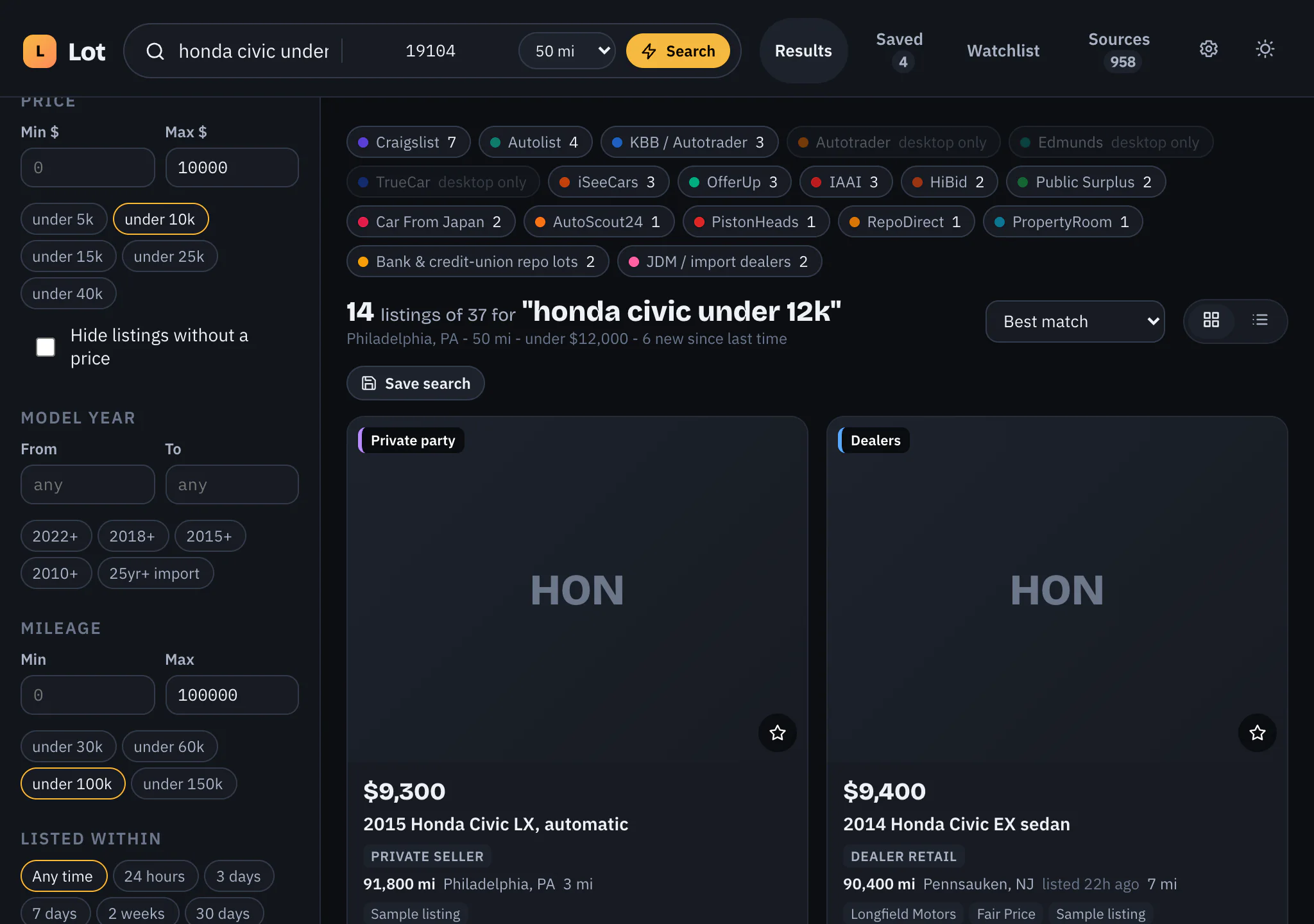
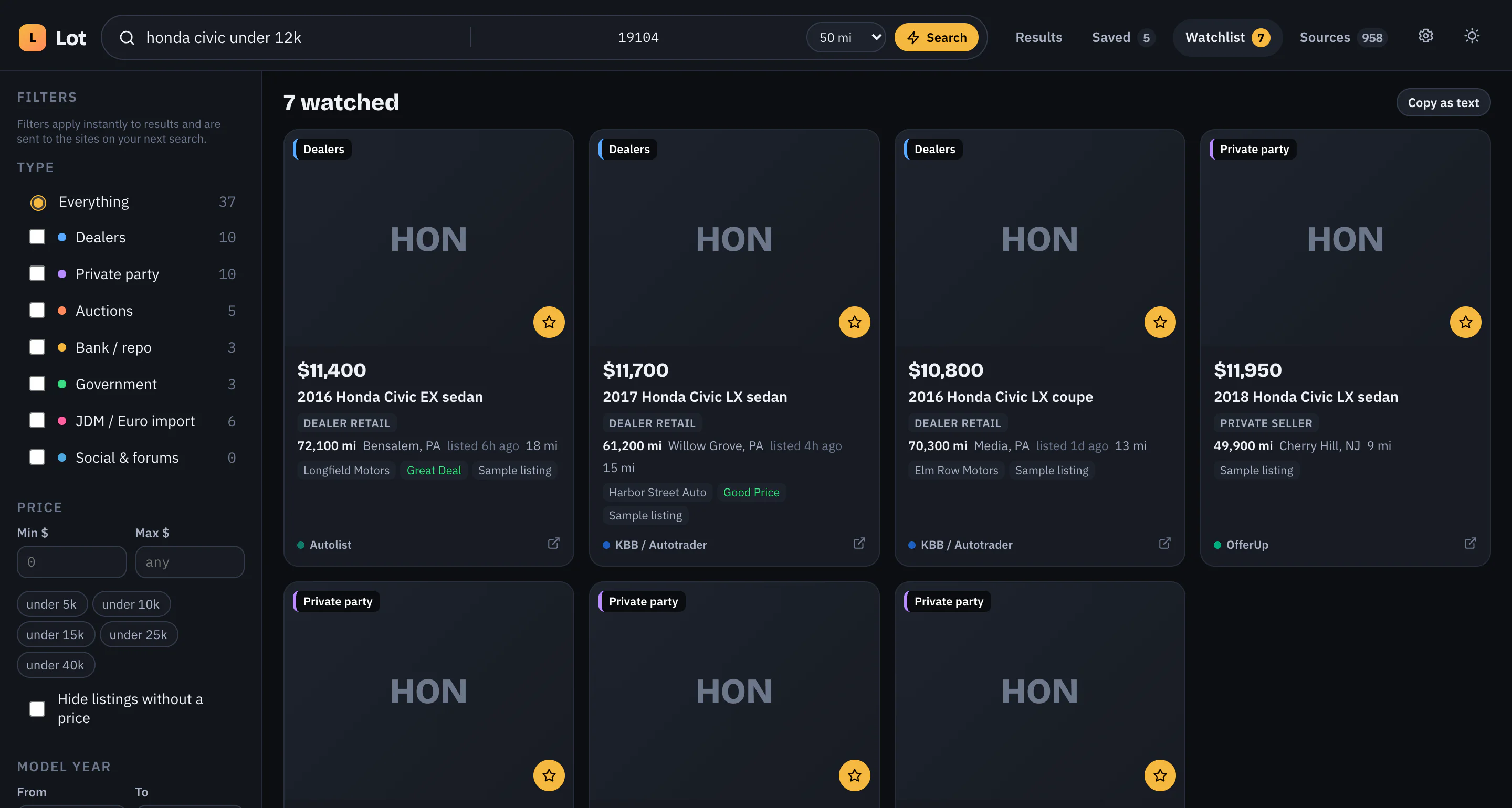
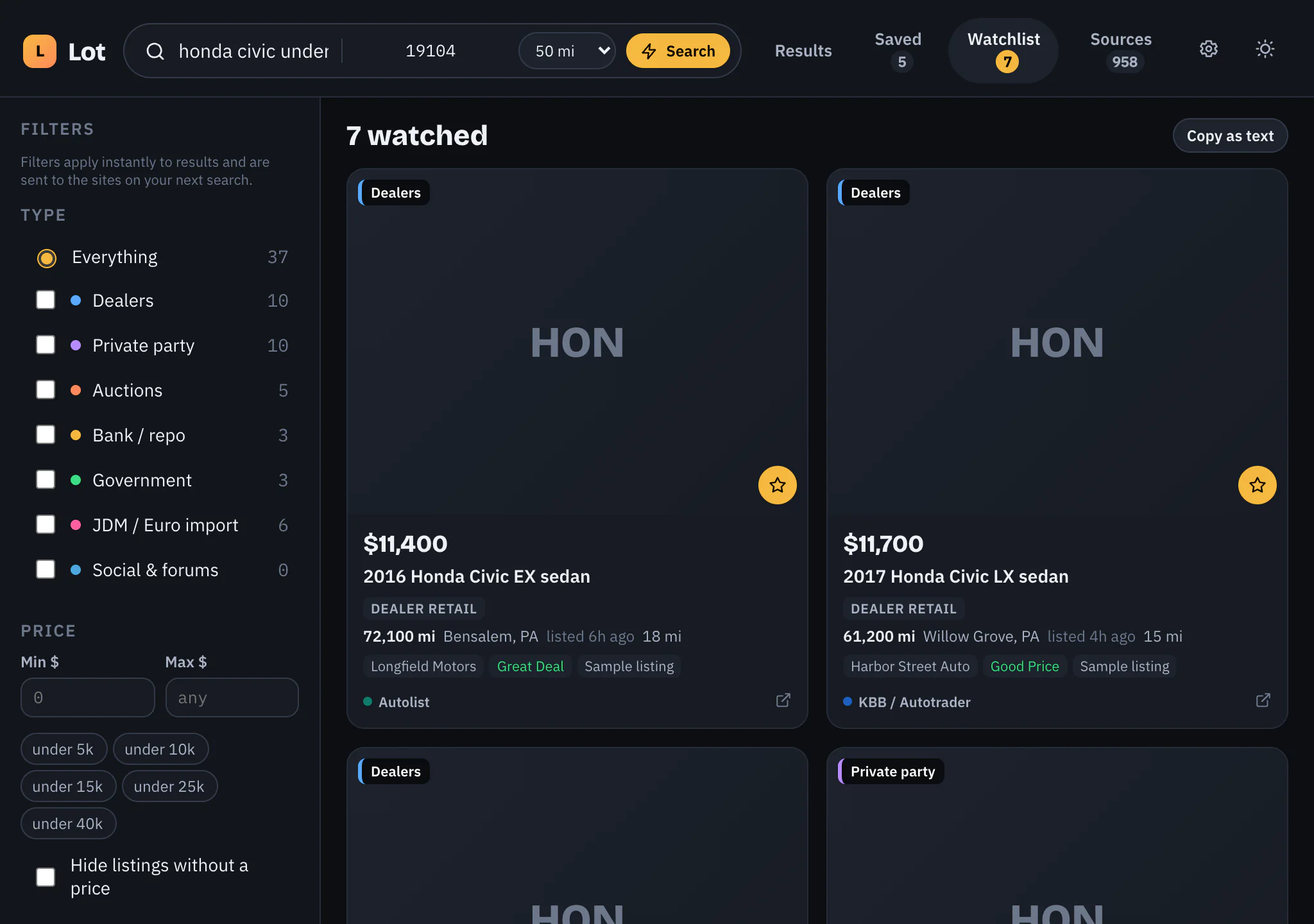
Every result is a card with the price, the miles, where the car is, when it was listed and which source it came from. A tag row says what it is. The source chips above the results show how many cars each source returned, and a source that cannot run says why: desktop only, needs a make, needs a key.
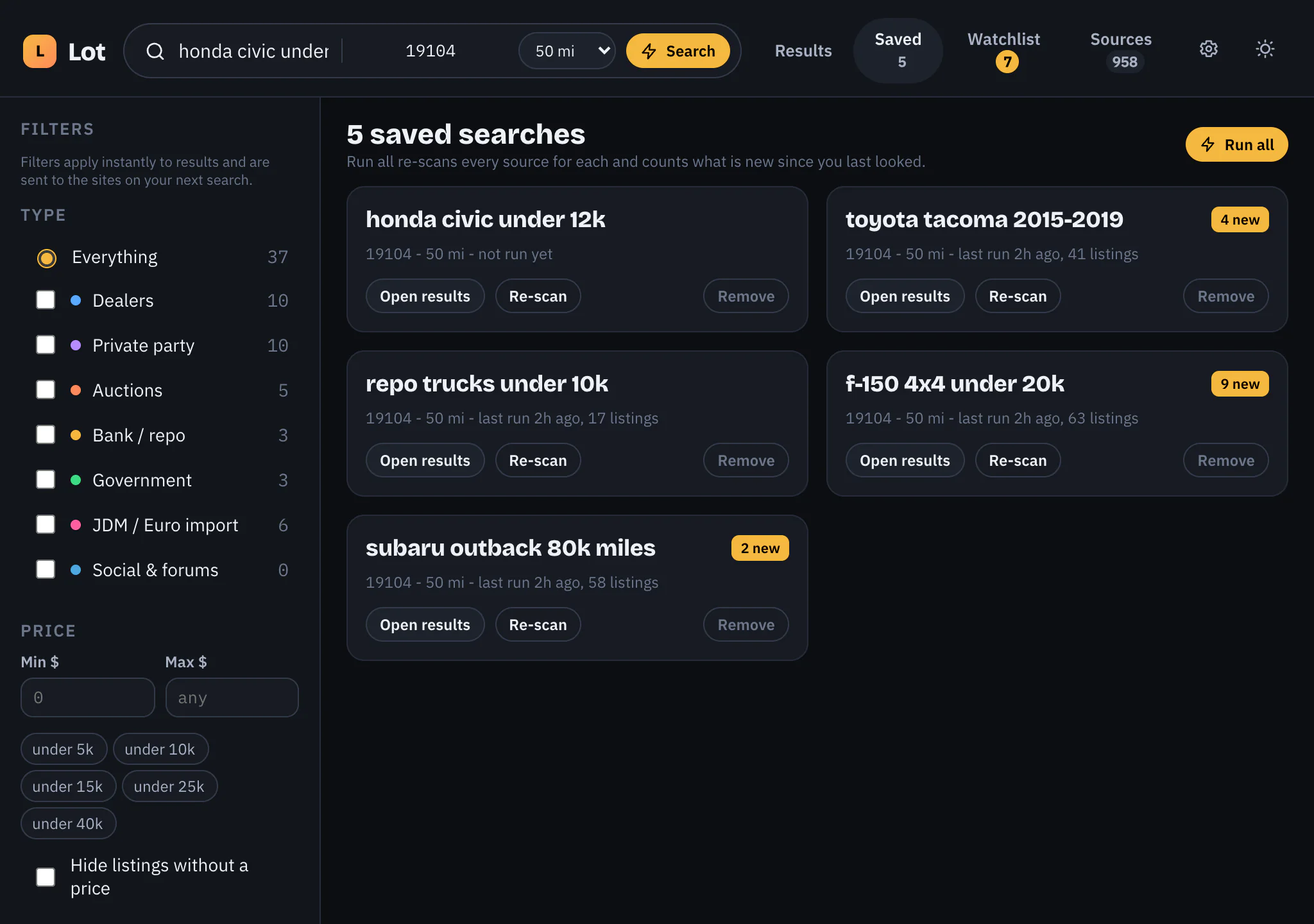
A car that is new since the last search carries a NEW tag. A star keeps a listing in the watchlist. Save search keeps the query, and Run all scans every saved search again and counts what is new.
Lot 0.1.0 is a Mac app for Apple silicon and Intel, about 13 MB as a disk image, with a light and a dark theme. The window opens at 1240 by 840 and will not shrink below 900 by 620.
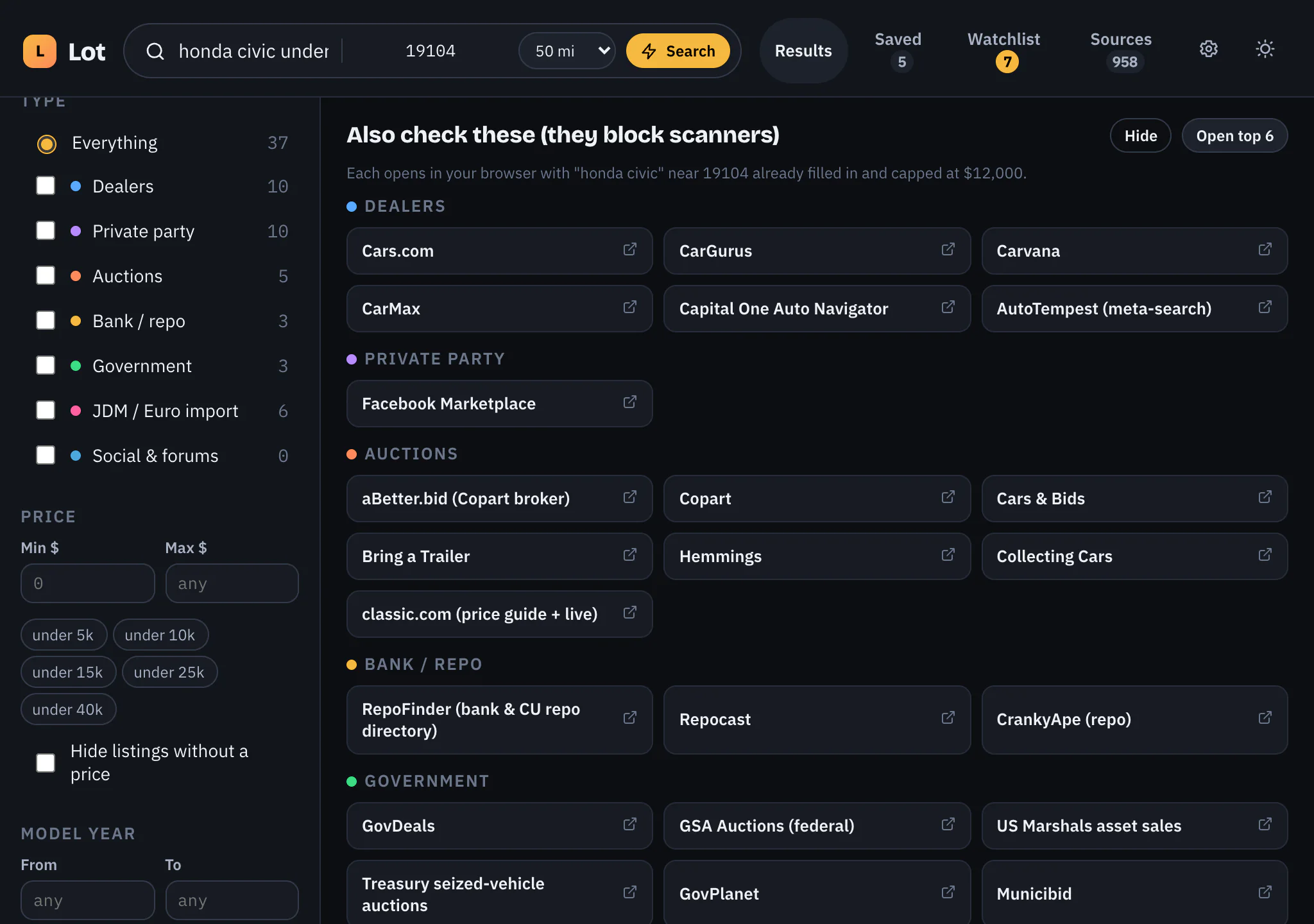
Cars that are not on a dealer lot: auction lots, government surplus and imports
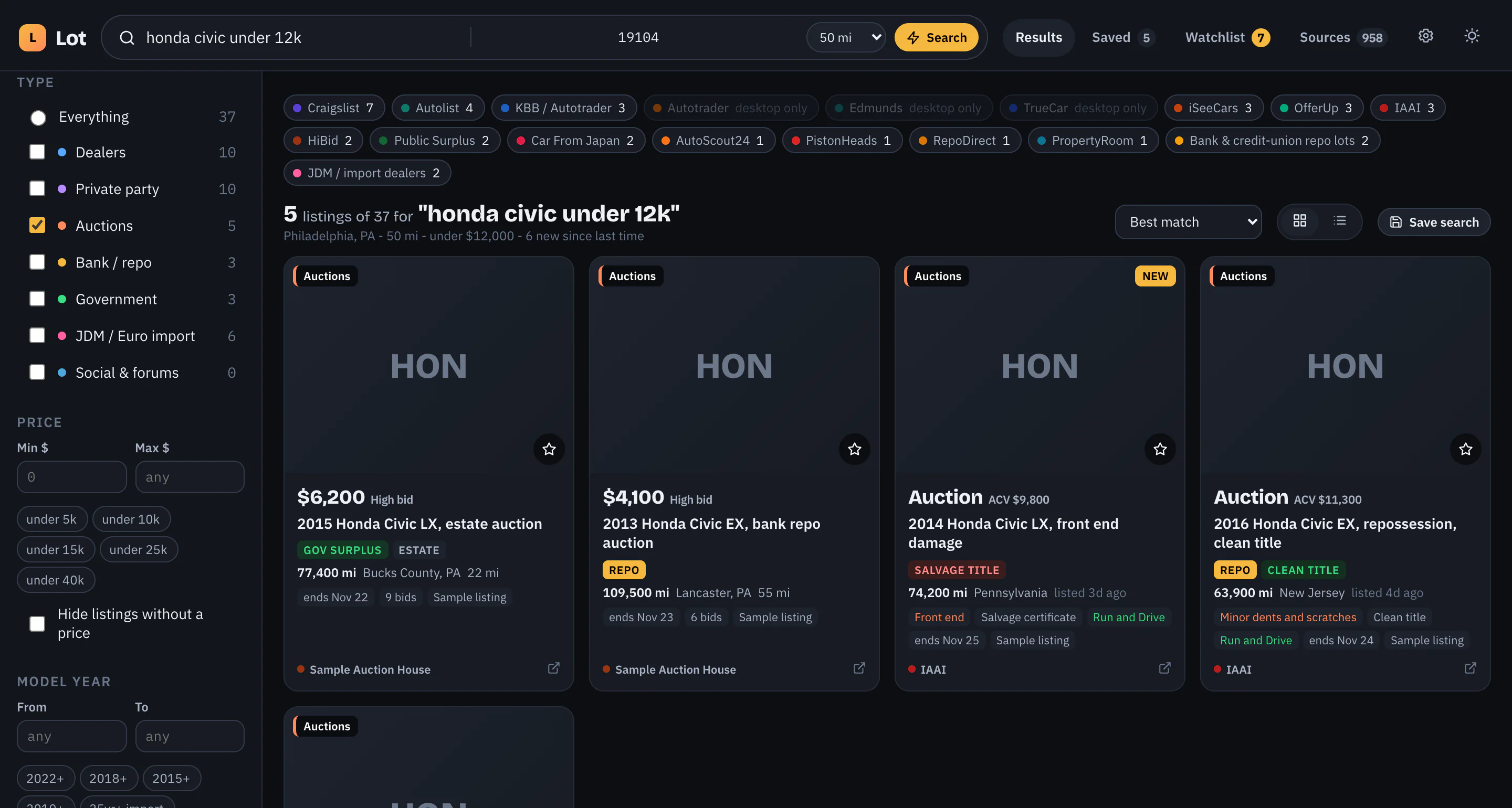
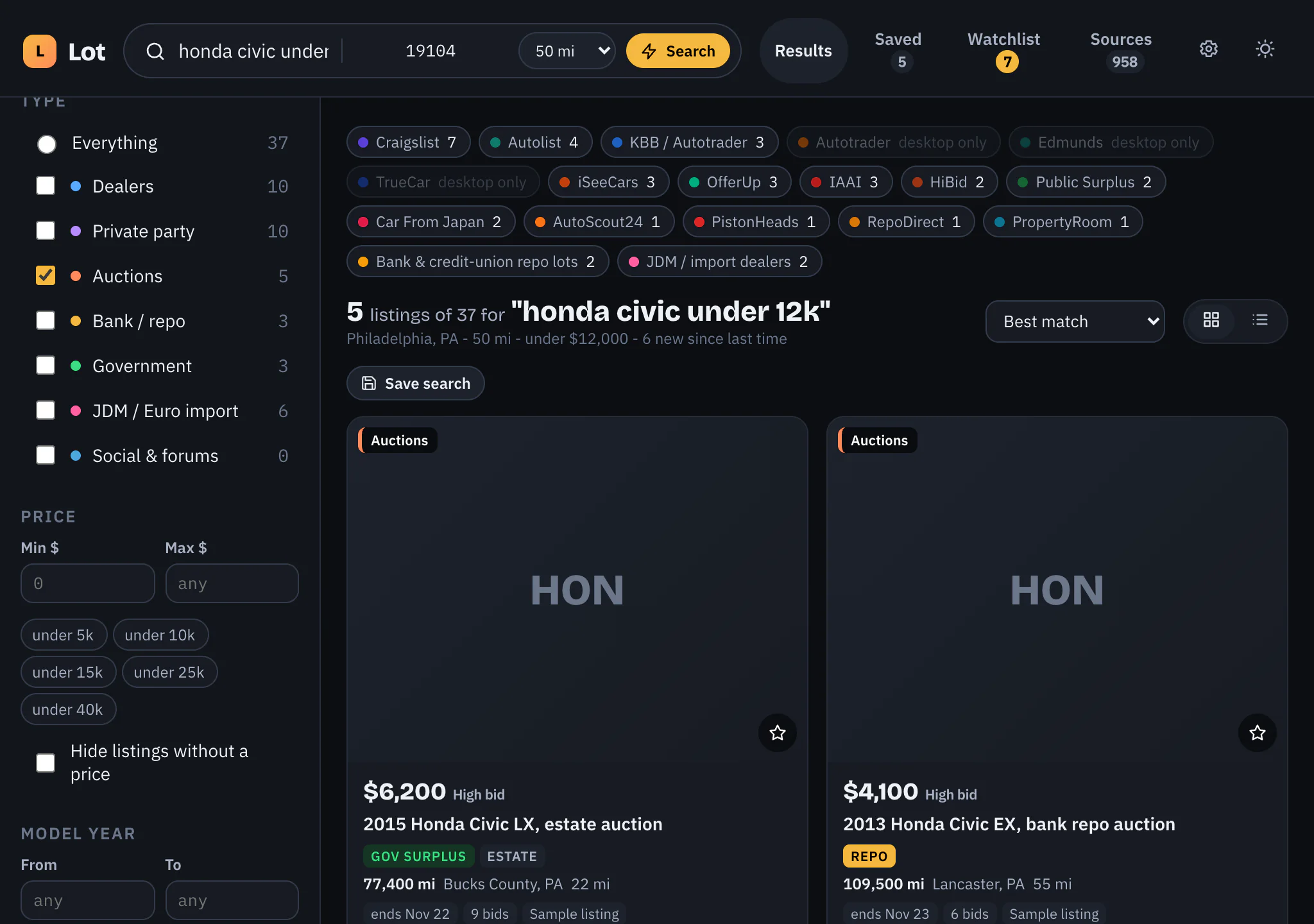
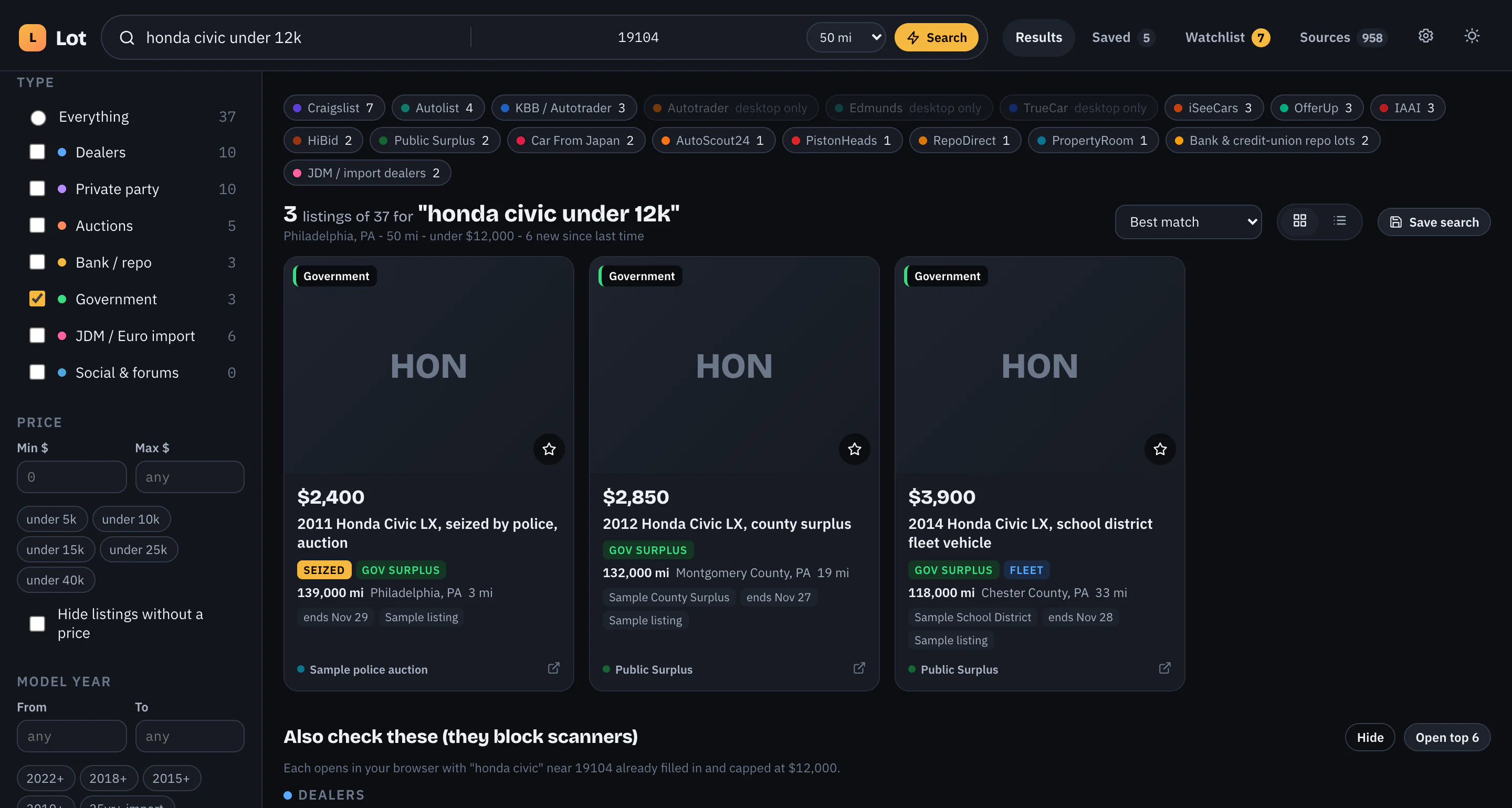
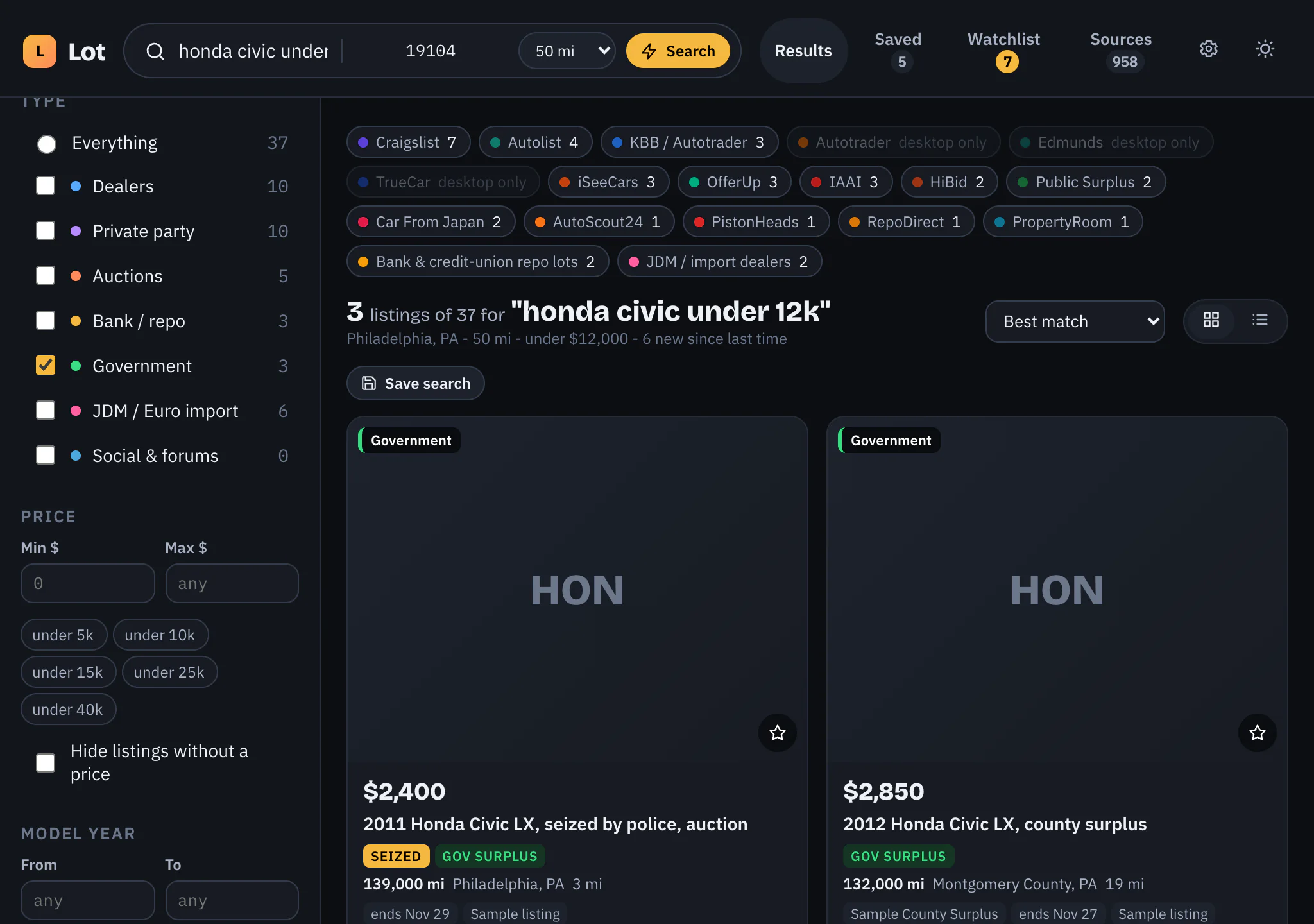
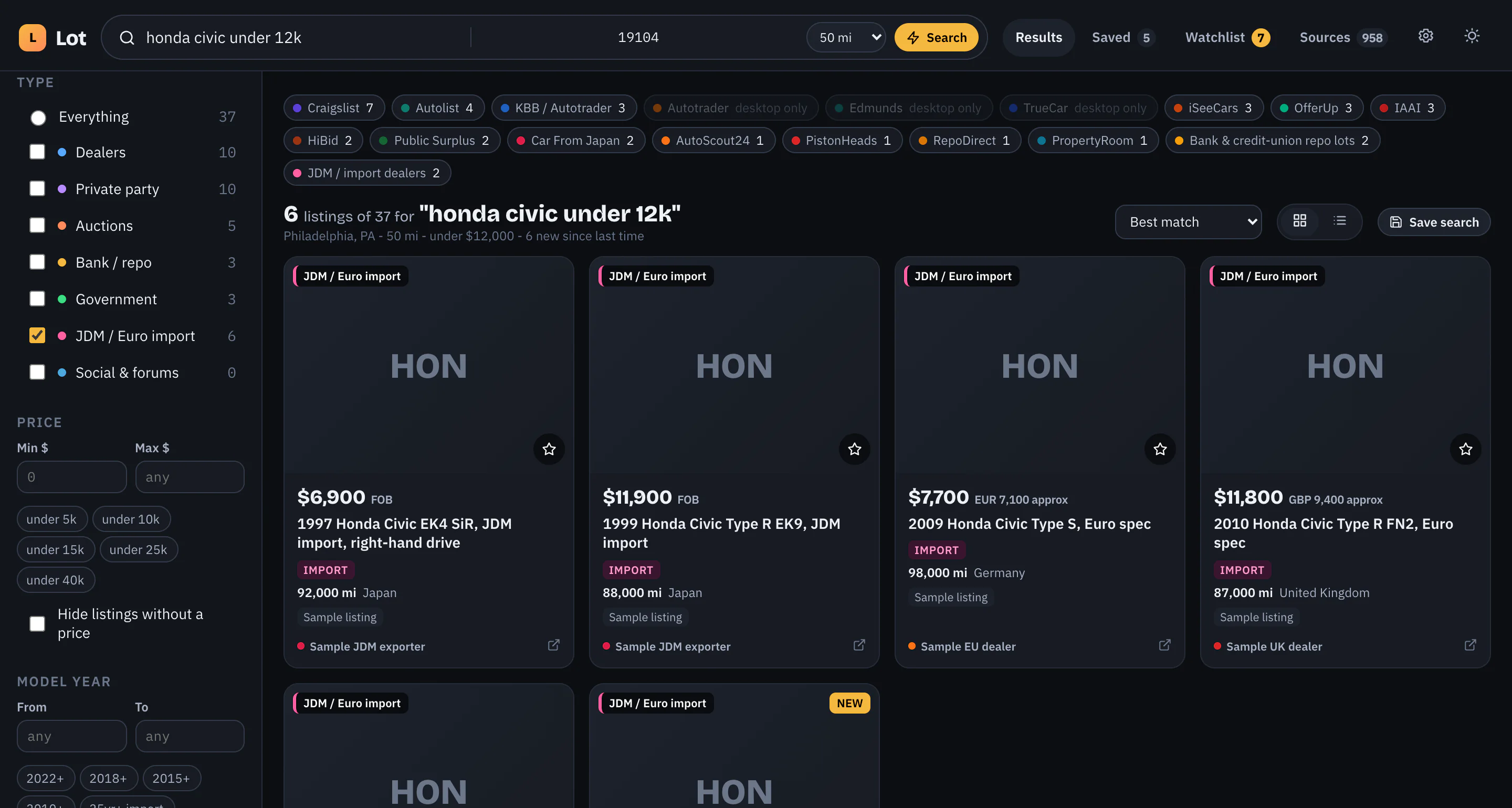
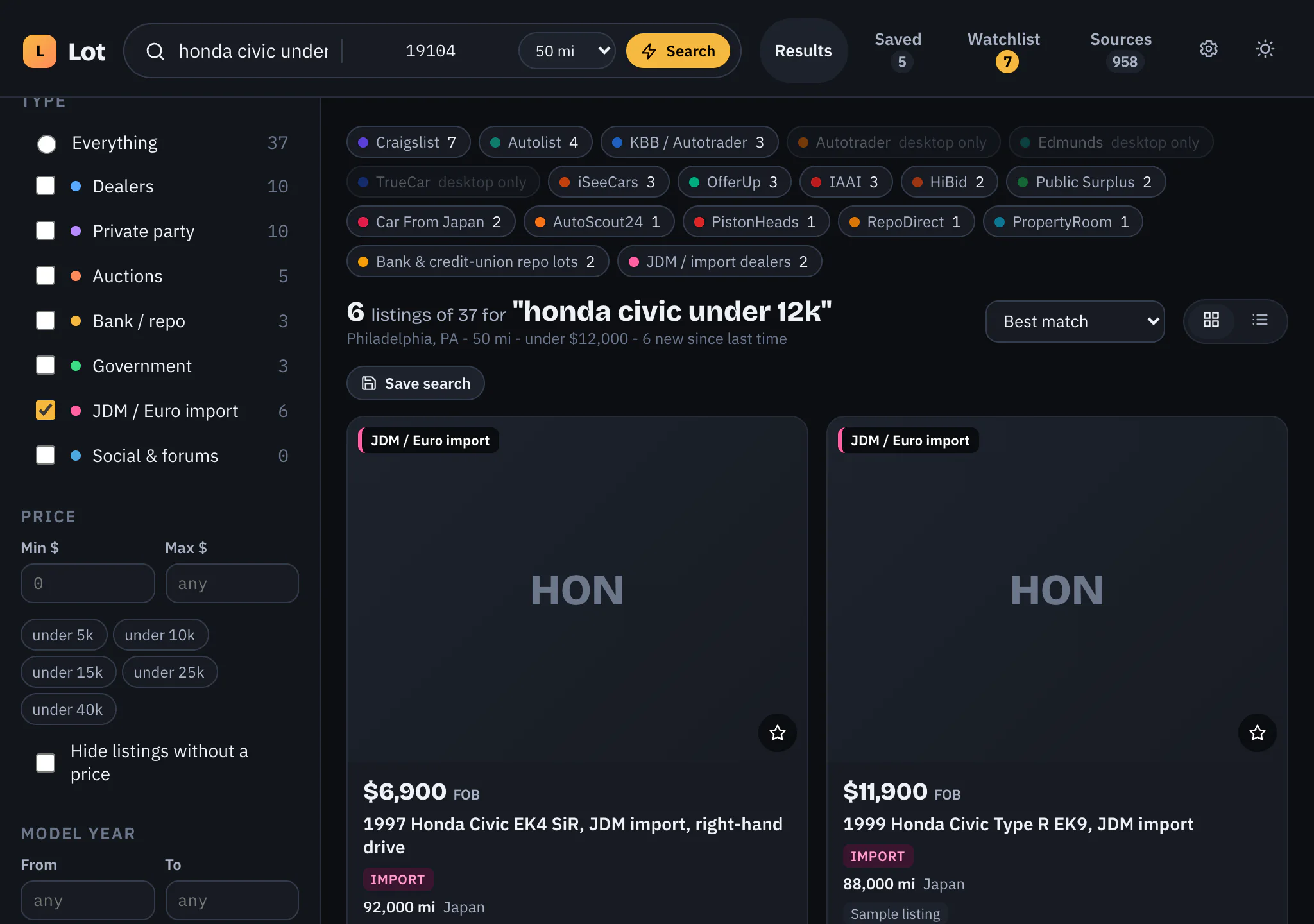
Sites that refuse every reader open as links, with your search already filled in
Lot 0.1.0 is built and running, and it is in development
Live: the Lot page, scroll it.
Lot 0.1.0 runs as a Mac app and reads 20 sources live, with 45 importer inventories read straight from the dealers' own sites. The Sources tab lists 905 in all. Results stream in as each source answers: the fast ones in about two seconds, the dealer scan in about 25.
Autotrader, Edmunds and KBB worked in a browser and failed in the Mac app. The built in network plugin was fingerprint blocked, so we wrote our own client in Rust with browser headers. It fixed those three and opened sites that block every other client.
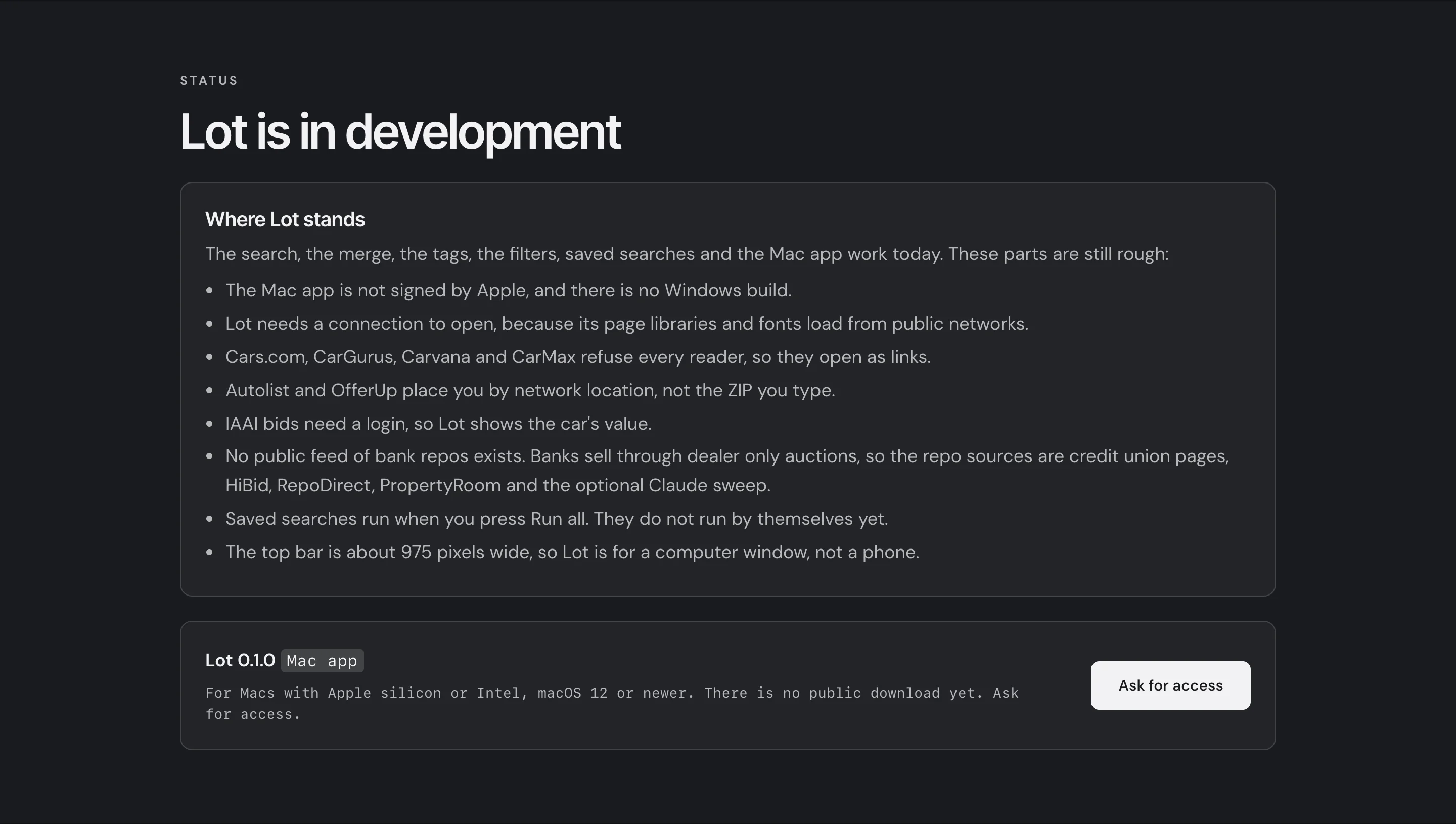
What in development means here. The search, the merge, the tags, the filters and the Mac app work today. Some sites refuse every reader and open as links: Cars.com, CarGurus, Carvana and CarMax. Autolist and OfferUp place you by network location, not the ZIP you type. IAAI bids need a login, so Lot shows the car's value instead. The Mac app is not signed by Apple, and there is no Windows build. There is no public download yet.
See how it works on the Lot page, or ask for access.
A finder should say where each car came from, and what it could not read
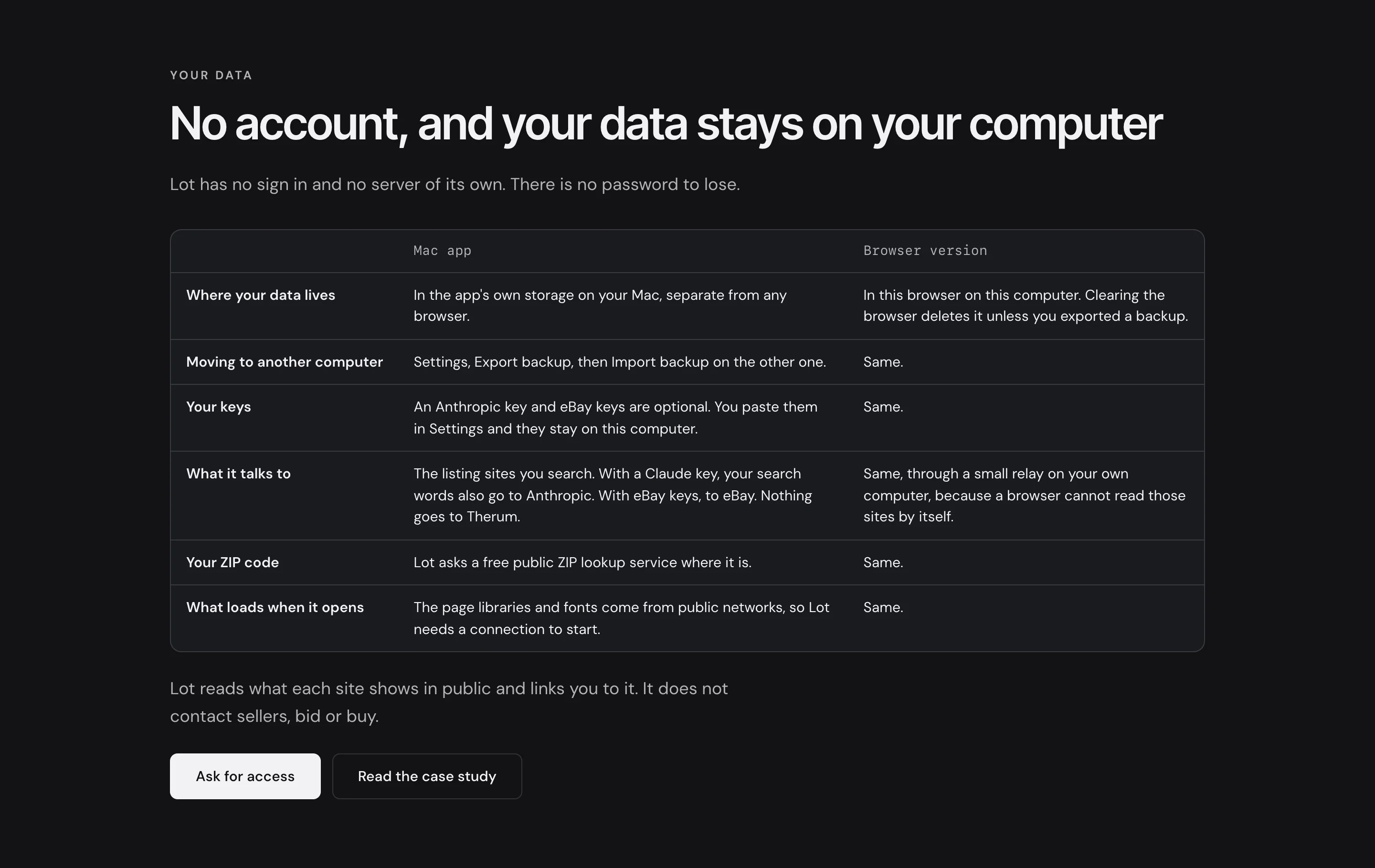
Lot reads what each site shows in public and links you to it. It does not contact a seller, bid or buy for you. The listing belongs to the site that posted it.
It keeps your search with you. There is no account, no password and no server of ours. And it says what it did: a chip for every source with its count, and a failed source shows the real error, so a zero is never a mystery.
These are the same habits Therum brings to client systems. The tool does the reading and the sorting. The person keeps the decision.